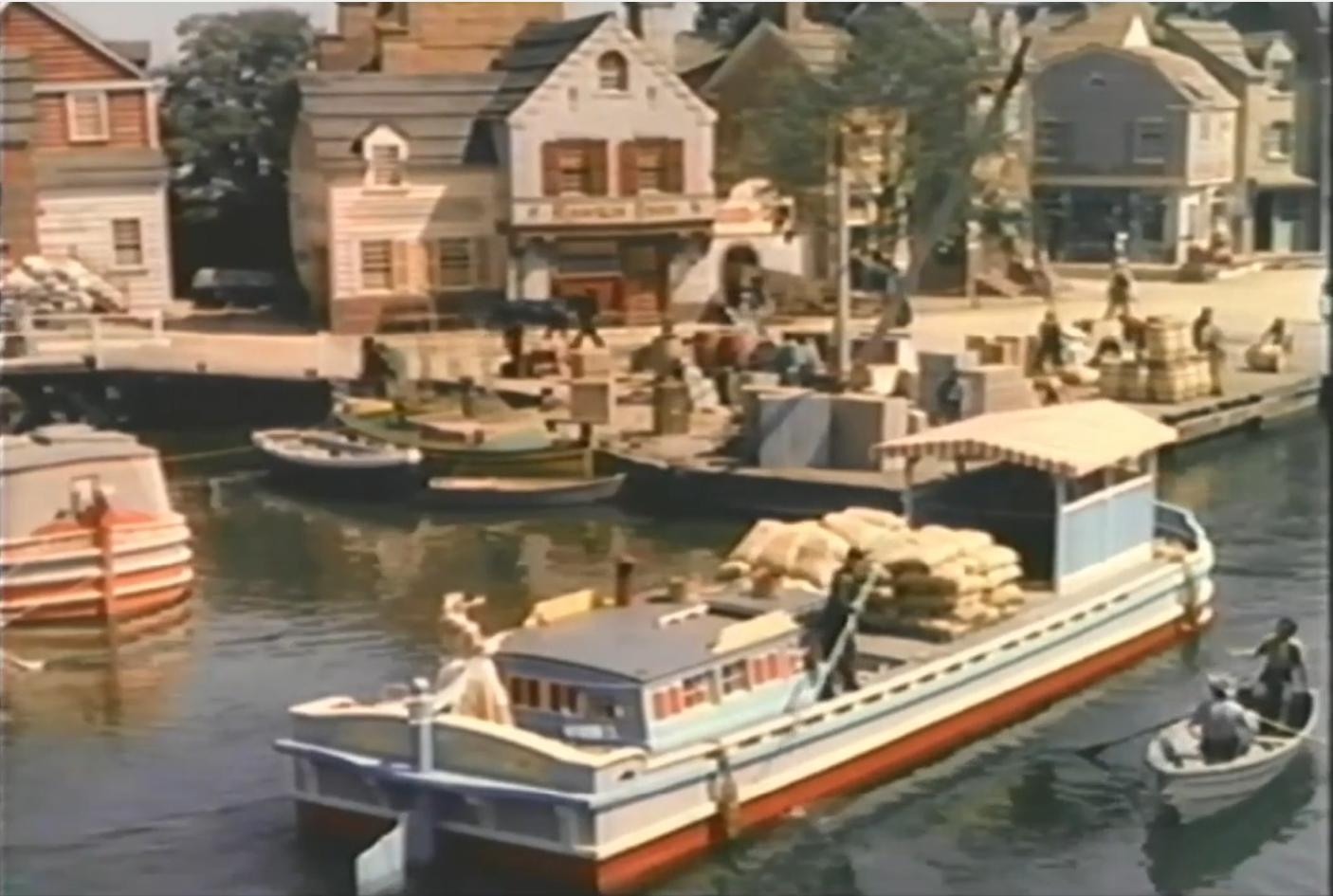
In an attempt to provide a realistic—and brief—illustration of life on the Erie Canal, I have excerpted canal and boat scenes from the movie, The Farmer Takes a Wife (1935) (Wikipedia) (IMDB), and arranged them in four one-minute clips.
The story takes place on the Erie Canal, but it was actually filmed on the Lehigh Canal. I believe the canal scenes in the movie present a realistic reflection of life on the Erie Canal.
There are four clips. Each is about one minute long. If you spot anything that strikes you as atypical of the Erie Canal of the 1850s (the period setting of the film), please share your observations in the comment section below or send me an email.
1. Canal & Boats
These clips show the canal and its boats. A brief segment shows a packet boat.
2. Neighbors
This collection of clips is intended to illustrate the neighborly intimacy of life on the canal.
3. Canal Towns
I purposefully removed the soundtrack from these scenes so it doesn't divert attention from the views of the town. Focus your attention on the background scenery (rather than the foreground/ actors).
In the scene at 0.19-0.26, notice the smoke rising from the boats' kitchen stoves and the laundry hanging on the clothesline.
As the characters walk, notice the stores along the canal (one of which they enter at the end of the scene); the Erie Canal is "main street."
4. Life Aboard
Illustrations of the interior of a freight boat are rare. (There is one in Richard Garrity's book, Canal Boatman: My Life on Upstate Waterways.) If these film scenes are anywhere near realistic, I think they would help to convey a sense of life aboard a boat. The furnishings are surely Hollywoodified and, consistent with the story line, the owner of the boat has been furnishing it in anticipation of buying a farm, so they are perhaps oversize for a canal boat. In this case too, I have deleted the soundtrack.
I have been hunkering down so long, it looks like hunkering
up to me.
A scene from perhaps 20 years ago plays out in my mind. I was
at a meeting crowded with social workers and case managers. From the back of
the room a voice called out, “Can anyone tell me the five stages of grief?” It
seemed an out-of-place question for a meeting convened to discuss the new laptop
computer-based case management system. For the past 40 minutes these social workers
had resisted and questioned the system. It intruded on their relationships with
clients; it slowed them down; it wasn’t necessary. “We don’t have to do this!” “It
won’t work because …” “It won’t work unless …” “It will never work!”
And then, this bizarre question from the back of the room.
Of course, in a room full of social workers, everyone knew Kübler Ross’s five
stage model of grief. One person after another answered the question,
calling it out one stage at a time. “Denial.” “Anger.” “Bargaining.” “Depression.”
“Acceptance.”
The voice from the back of the room spoke again. “What stage
are you in now?”
The pertinence of the question became apparent. There was a
long pause as the social workers recognized they were grieving their old ways
of working. They were in denial. They were angry. They were bargaining. They
were depressed.
The pause continued awkwardly until one of them said, “OK,
how can we make this work.”
Acceptance.
*****
From my work with computer viruses, I knew something about how
they spread so, for this pandemic, I fast-forwarded right past denial, anger,
and bargaining and went straight to depression. As I stay at home day after
day, distance myself from others when I do go out, monitor every doorknob,
steering wheel, and can of beans I touch and wipe them down afterwards and wash
my hands, I hold depression at bay and lean to acceptance. I accept this new
normal. This is it.
*****
An old Jewish story comes to mind. My retelling draws on a version by Doug Lipman.
Two
students are studying the psalms and they come to the line, “This is the day
God has made, let us rejoice and be glad in it.” (Psalm 118:24.) They are
troubled by it, so they ask their rabbi, “On a day when everything is good, it
is easy to say this line with a full heart. But, how can we say it with genuine
intent on a bad day?”
“A good question,” says their rabbi. “For this question, “you
should visit Reb
Zushya.”
To find Reb Zushya the students must travel, by foot, to a
distant village. On the third day of their journey they arrive in the heart of
the village. They ask, “Can you tell us where we can find Reb Zushya?”
“Sorry, we don’t know anyone by that name.”
They knock on many doors, receiving the same response. They continue
to inquire further and further from the center of the village; they begin to
despair. Finally, someone responds, “I recall a man who used to be known by
that name. He lives some distance from here.”
The students follow the villager’s directions and proceed
down a narrow street, which turns into a dirt road, which turns into an
overgrown footpath. They see a small building ahead – a shack, a hut. As they
approach, they notice a window covered with cardboard, the roof missing some shingles,
the outer door hanging askew from its upper hinge. They knock at the door. A
voice from within whispers, “I’ll be with you soon.”
In time, a man opens the door from within and asks, “What
can I do for you, my sons?”
“Our rabbi sent us here to ask a question. Are you Reb
Zushya?”
“Yes, I am. Welcome, come in, but please be quiet. My wife
is very ill, and she has just gone to sleep.” He pointed to a blanket drawn
across the opposite corner of the small room. He waved in the students and pulled
up two wooden boxes so they could sit at his wobbly table, filled three wooden
cups with water, and broke his remaining bread in three pieces. When they each had
something to drink and eat, he asked, “So, what is this question you have come
here to ask?”
One of the students explained, “We were studying the psalms
and came to the line, ‘This is the day God has made, let us rejoice and be glad
in it.’ We were troubled by it, so we asked our rabbi. ‘It is easy to say this
line with a full heart on a good day, but how can we really mean it on a bad
day?’ Our rabbi told us, ‘This is a question you should ask Reb Zushya.’ So,
here we are.”
Puzzled, Reb Zushya looked at one student and then the other
and then leaned back a bit. Shaking his head slowly, he replied, “I don’t know
why your rabbi sent you to ask me this question, I have never had a bad day!”
*****
This virus – like ones before it and ones that will follow –
is no laughing matter. But, in the spirit of hunkering up:
Two buddies walk into a bar. The bartender says, “What’ll
you have?” The first one says, “I’ll have a Corona.” The second says, “I’ll have
what he’s having.”
Scientists have observed a number of similarities among the
various virus outbreaks and have demonstrated that the viruses are copying from
each other. It’s a clear‑cut case of plague‑arism.*
Did you hear the joke about the virus? Never mind, you
probably won’t get it.*
Jewish irony: Passover curtailed because of a plague.*
Many of my fellow storytellers and musicians have announced
cancellations of their performances. Without minimizing their difficulties, I
would like to announce I will not be performing at Carnegie Hall, Radio City
Music Hall, or Madison Square Garden.
* Shamelessly adapted from the Internet.
*****
My title plays on Richard Fariña‘s
1966 book, Been
Down So Long It Looks Like Up to Me. In closing, I refer to Jack Kerouac‘s 1962 novel,
Big Sur. It’s a
fictionalized autobiography in which the main character deteriorates,
physically and mentally, in what seem to be irretrievable downhill slides.
Then, as the book concludes, comes an artful turnaround. Redemption is not out
of reach. Kerouac writes what we hope for.
The Erie Canal appears on the 2001 New York State Quarter – as an afterthought. If you look carefully, you’ll notice the line extending north from New York Harbor to Albany where it makes a sharp turn to the west and continues (passing behind the Statue of Liberty) to Buffalo. Yes, that line represents the Erie Canal, the “gateway to the west.” Indeed, the “Gateway to Freedom” design that won the competition for the 2001 coin beat the “Erie Canal” designs that was submitted (see various alternative designs below).
It looks like the Erie Canal will yet have its day on a United States coin. As shown below, a design depicting a mule-drawn barge on the Erie Canal was recommended by the U.S. Commission of Fine Arts for the U.S. Mint's American Innovation™ $1 Coin Program.
It’s not yet a sure thing. The design recommendation is subject to adoption by Secretary of the Treasury Steven Mnuchin, who has final say. It’s possible he might select one of the competing Erie Canal designs, shown below, or one of the baseball designs or Apollo lunar module designs that were submitted.
In any case, the final version won’t be known until the engraving is compete, translating the chosen design into a mintable coin.
As for those who prefer an image of the Statue of Liberty, fear not. She will appear on the obverse of each and every coin in the American Innovation Dollar Coin series.
For the coin that was actually minted, read Part II, here.
“Songs have been the not-so-secret weapon behind every fight for freedom, every struggle against injustice and bigotry.” ~ E. Y. Harburg
Here’s an easy question:
Which song is sung publicly more often than any other in the United
States?
Answer: The Start Spangled Banner
(Happy Birthday to You is undoubtedly the most often sung, but in private rather than public settings.)
Here's a harder question:
Which song is sung publicly second most often?
(It's not Auld Lang Syne, which is sung publicly, but only once
a year.)
Ready for a hint?
Seventh Inning Stretch
That‘s right, Take Me Out to the Ballgame, sung by crowds of strangers at just about every one of the
thousands of baseball games played each year (albeit only the chorus).
How did the song get to be so well known?
It’s a long and fascinating story. Here's the short of it:
This 1908 song sold six million copies of sheet music in an era when there were only 20 million U.S. households. Perhaps one out of every three or four households had a copy. It was sung in the fledgling movie theaters that blossomed all over the country. Beautifully hand-colored “magic lantern” slides, projected on the screen, helped tell the story of “Katie Casey” who was “baseball mad.” However, it wasn‘t really about baseball! Without lecturing or preaching, it embraced the “New Woman,” a woman who was independent, outspoken, interested in
sports, and deserved to vote! It was
Suffrage’s Secret Song!
The story tells of the songwriters, Jack Norworth and Albert Von Tilzer, the most famous female stars of the day – Trixie Friganza, Louise Dresser, and Nora Bayes (think Madonna, Lady Gaga, Barbara Streisand), Frederick and Louis Rueckheim – creators of Cracker Jack®, and the early history of movie theaters and music publishing. I'd love to tell you the whole story and sing the entire song accompanied by those 1908 song slides. Please see my upcoming shows or contact me to schedule a performance.
Credits:
The image of the woman and bicycle is adapted from the front cover of Jugend, 18 July 1896, No. 29.
The “Votes for Women” sash was made for the Women's Political Union in New York City, 1910-1915. (Image used with permission from Jeff Bridgman.)
In honor of the the 200th anniversary of the Erie Canal (constructed
1817-1825), here are some movies – fictional and documentary – that feature the
Erie Canal. Segments (minutes) are given that illustrate or describe the
canal.
Based on the 1929 novel,
Rome Haul, by Walter Edmonds (which was also the basis for the 1934 Broadway
production
(Wikipedia,
IBDB)), most of this movie involves the Erie Canal. Stars Janet Gaynor and Henry
Fonda (in his first movie appearance), directed by Victor Fleming. Many canal
scenes appear throughout the movie. This scene, which takes place in a tavern,
renders a comic version of Low Bridge, Everybody Down.
A DVD of the movie was released by 20th Century-Fox's Cinema Archives and is
widely available. Also, you can watch the entire movie
here.
Another movie based on Walter Edmond's Rome Haul, this one is a musical
adaptation with songs by Harold Arlen and Dorothy Fields. Stars Betty Grable
and Dale Robertson, directed by Henry Levin. Many canal scenes appear
throughout the movie. You can watch it
here. or here.
The Farmer Takes a Wife, 1940, 1953
The play was adapted for radio, twice! Listen or download the mp3 here:
As John Wayne leads the U.S. Calvary on horseback across the dusty desert
southwest, he calls out, “Singers, give us a tune!” The chosen song?
Low Bridge, Everybody Down (The Erie Canal Song). Stars Maureen O'Hara
and John Wayne, directed by John Ford. Watch it
here. Minutes: 49:12-49:48
Episode 1: The Country and the City (1609-1825); Chapter 10, A
Larger Destiny: The Grid and the Canal
Minutes: 1:33:19-1:43:05
In the next episode of the series,
Episode Two: 1825-1865, Order and Disorder, Chapter Two, The Metropolis of
America, the important role of the Erie Canal in the growth on New York City is
highlighted - minutes 6:38-8:03.
15 Miles On The Erie Canal - Part 1 (2006)
15 Miles On The Erie Canal - Part 2 (2006)
America's Heritage: The Erie Canal (1957)
Carver Companies Move GE Steam Turbines (2016)
That's all for now! If you know of any other Erie Canal scenes at the
movies, please let me know.
While working on a story about Yankee Doodle (which is a great story, by the way), I came across the following song, written for Thomas Jefferson’s inauguration as President of the United States. Sing it to the tune of Yankee Doodle. Any inferences you might make as to its pertinence to current events are your own.
While some on rights and some on wrongs,
Prefer their own reflections,
The People’s right demand our songs
The Right of free elections.
Law and order be the stake,
With freedom and protections.
Let all stand by the ballot box,
For Fair and Free elections.*
For Government and order’s sake
And Law’s important sections,
We should support and pleasure take
In frequent Free elections.
Our Agricult’ral int’rest, Marts,
And Mercantile connections.
With Manufactures, Science, Arts,
Must thrive by free Elections.
To thwart the schemes of Factious bands
Who for us plan subjections,
The cause of Liberty demands,
Our Votes at all Elections.
Should enemies beset us round
Of foreign fierce complexions.**
Undaunted we can stand our ground
Upheld by free Elections.
Elections are to make us laws,
For trade, peace and protections
Who fails to vote forsakes the cause
Of Fair and Free Elections.*
We’ll never from our duty swerve,
Let who will make objections,
But while we live, unchanged preserve,
The Freedom of Elections.
* Verses in the Fair and Free Elections version that differ from the original.
** As used here, I take “complexion” to mean “a complex of attitudes and inclinations” or “overall aspect or character” rather than “the hue or appearance of the skin and especially of the face” (Merriam-Webster). Nonetheless, you might prefer alternative lyrics such as:
“Intent on vote deflections,” “Changing our directions,” or “Tricking our affections.”