Sunday, October 25, 2015

Sandy's Seven Sagacious Storytelling Sayings

OK, I’m a sucker for alliteration. Nonetheless, when I led a series of storytelling sessions, six days in succession, each with a new set of students, I noticed myself saying the same things over and again. As it turned out, they numbered seven. So here they are, pearls of storytelling wisdom or otherwise, Sandy's Seven Sagacious Storytelling Sayings. (Download a pdf version here.)

1. An audience of one.

One of my early storytelling performances was at a Tellabration organized by the Story Circle of the Capital District. We were eight tellers and about 350 people in a semi-circular theater that held about 400. A wonderful turnout. When my turn came I stood alone on the stage and slowly turned my gaze from left to right, trying to acknowledge and connect with the audience. I told Lucky Numbers, a story about my father, and how I had questions I would like to ask him, questions that I realized only after he had died.

After the performance, the tellers and many people from the audience gathered in a nearby restaurant for “beer and cookies” – and more stories. One man, whom I had never seen before, came up to me and shook my hand. “Thanks for that story,” he said with tears in his voice, “I needed to hear that.” That’s all he said, and then he disappeared back into the crowd. Since then, I try to remember that it’s not the audience who hears a story, but each individual person. One person, perhaps, will find something meaningful in my story. I have to tell my story to only that one person and it will be worthwhile. And if it is meaningful to that person, it is probably meaningful to others.

2. Tell the ending.

It is my dream to tell An Evening of Endings, a storytelling performance built around the last lines of my stories. In my dream, I offer the audience a list of endings and they get to choose which ending they would most like to hear. All I really want is to tell the ending of the story; that’s what counts most, it’s why I want to tell the story in the first place. But, for it to have any meaning, I need to tell them the beginning and the middle.

Put another way, it’s easy to rehearse your story, starting at the beginning each time, and pay a great deal of attention to the beginning and the middle, but then run out of rehearsal time before you get to the end. If, when you rehearse the next time, you start again at the beginning, you may never spend adequate time thinking through and rehearsing the end.

Put yet another way, when you develop a story, pay attention to the beginning, because that’s what attracts the listener’s attention, and pay attention to the middle, because that’s what carries the story and retains the listener’s attention. But most important, pay attention to the ending, because that’s what brings it all together – and generates the applause.

3. Use the Vulcan Mind Meld.

I have long admired the Vulcan Mind Meld as a perfect form of communication. (If you are not familiar with it, this is a method used in the science fiction world of Star Trek to join minds together – “My mind to your mind, my thoughts to your thoughts.”) Since it is a fictional ideal, we must use the next best things: images and words. As a storyteller, I might think my vehicle is words. But this is incorrect. In my head I have an image, and I want to get that image into your head. Words are the vehicle, but the image is their source and destination. By being aware of the images I have in my head, and how I zoom in or out and switch from one to the next, I can tell a better story and produce better images in the heads of my listeners.

4. Tell a story that the listener needs to hear, or one that you need to tell.

I attended a dinner at a professional conference and sat next to a person I had only recently met. Before long, steeped in conversation, she started telling me about her sister. It seems her sister struggled with severe social anxiety and was under the care of a doctor who managed her medications. After listening for some time, I told her the story of the Turkey Prince. I didn’t know if that story would be of any help but I thought it might. When she saw me the next day she came over to thank me for telling that story. It is a good day for storytellers when the stories they tell are useful for their listeners to hear.
Sometimes I tell a story because I need to tell it. It represents something meaningful and important to me and I feel good when I tell it. With apologies to Descartes, “I have shared my story, therefore I am.” When the story I need to tell and the story the listener needs to hear are the same story, it is a very good day.

5.There is always another side to the story.

Whenever I or one of my sisters would complain about what someone did, describe what happened in some incident, or comment on something we read in the newspaper, my father would say, “there is always another side to the story.” It helped us build perspective, to appreciate that no matter how confidently someone told their side of the story or how sure we were of our own understanding, there was always another way to look at it. For a storyteller, this is all so true. We can tell a story from the point of view of any of its characters or objects. And even if we don’t, it’s often useful to think about the story from different perspectives as a way to gain a fuller understanding of the story. But we don’t have to tell every side of a story, we need only tell one side – and let the listener wonder about the others.

6. My story gets longer before it gets shorter.
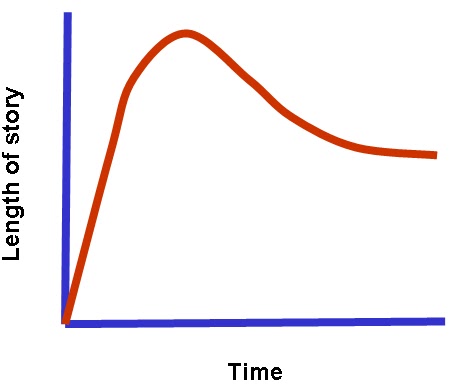
I usually start with an idea – or some related ideas – of a story and then develop it. Whether I write it down in narrative or outline form, or keep it all in my head, it grows. It gets longer and wider and then, as I shape the story – deciding which details to omit, retain, add, and expand – the story starts to get shorter. I allow the story to get messy, knowing that before long it will settle down. I’m not smart enough to know how it will end up, so I have to wait to find out. And that’s OK.

7. Every story I tell is a story about me.

This is clearly the case when I am telling a story about myself, or a story about family or friends where I am a character in the story. But I am trying to say something broader. Every story I tell says something about me. The stories say something about me simply because I choose to tell them. They are meaningful to me – I am attracted to them in some way, and that says something about me. The way I tell it, what I emphasize, what I omit, what I change, what gestures and expressions I use, how I involve the listeners, all tells a story about me. If you have a story that isn’t about you – about what you find important, meaningful, humorous, intriguing – don’t try to make it fit; don’t fake it. Instead, tell a story that says something about you.


So ends Sandy's Seven Sagacious Storytelling Sayings. They are not sufficient! I’m eager to savor the succinct storytelling suggestions you supply.

This article appeared in Storytelling Magazine, 31:2 (June) p. 15. (2019). Download a pdf version here

Friday, May 8, 2015

It’s Hard to Tell a Hug

My father was a storyteller. It was his everyday way of communicating. I discovered that I too am a storyteller. I have retold his stories and told my own stories about him. I told so many stories about my father—and then it dawned on me. I wasn’t telling any stories about my mother. I began to feel bad. Surely, she deserved to have stories told about her. I thought about it. Why wasn’t I telling any stories about my mother? I didn’t have any stories about my mother! My father was a storyteller, so it was easy to tell his stories, but my mother was not. And while it’s easy to tell a story, it’s hard to tell a hug.
~ ~ ~
When I was four years old my mother asked me for the very first time if I wanted to stay home alone. My three older sisters were at school; my father was at work; I was home with my mother, and when she had to run an errand, I had to go with her. That was just the way it was. But here, for the first time, she said, “I have to go shopping. Would you like to stay home or do you want to come with me?” I used to get a headache going shopping—what am I saying, I still get headaches going shopping—so I said, “I’ll stay home.”

As soon as she left, I wanted my mommy. I thought, Maybe she’ll come back for her keys. She was always forgetting her keys. So I put on my coat—she had bought me this dressy, full-length coat. And it was itchy wool that I hated. It was a black and white weave with a matching hat. I pulled that hat over my head and the earflaps over my ears and I tied that itchy wool string under my chin—I hated that hat more than the coat—and I stood there in the middle of the living room waiting for my mommy.

When finally she returned, she opened the door, saw me standing there in the middle of the living room with my hat and coat on, and instinctively, intuitively, she knew exactly what was going on. She quickly leaned down to put her packages on the floor, rushed over to me, picked me up in her arms and hugged me, and I was … relieved. And I cried and she cried and her whole body shook. She was not a slight woman and when she held you and her body shook, you really knew it. After some time I regained my composure, and my mother regained her composure, so she put me back down and we went about doing our little-boy-and-mommy things.
~ ~ ~
When I was twelve years old my Boy Scout troop was going to summer camp for the first time. We went camping once a month religiously all through the school year but we had never gone camping during the summer, much less for two whole weeks. When I heard this in the beginning of the year, I really didn’t believe it. I thought sure that, by the time the summer rolled around, for one reason or another this deal would have dissolved. To say that it was beyond my wildest dreams would suggest too high a degree of probability. It was just inconceivable, other­worldly, and I didn’t take it seriously until that day my parents drove me to the Port Authority Bus Terminal with my foot locker and my backpack and I joined my fellow scouts on the bus to the Ten Mile River Boy Scout Camp in the Catskill Mountains. I didn’t think about home once until the weekend in the middle of our two-week stay, when the camp had “Parents Day.”

Our campsite was set along the sloping ground of a wooded hillside. At the top of the hill was the dirt roadway; a footpath led down the hill through the woods until you came to a level area. Here was a clearing with a huge boulder, our campfire circle, and also the main cabin, where the scoutmaster stayed. Then another long slope until the campsite leveled off again. That’s where the lean-tos were, where all the boys stayed. We were down there, all the boys, expecting our parents to show up before long, and we were neatening things up, shaking the leaves out of our sleeping bags, trying to make it look like we were taking care of the place, when I heard this voice bellowing from the top of the hill.

“Schuman!!!”

And there was my mother, a large woman, impatient to see me, bounding down that hill. I strode up the hill to meet her and we met in that campfire area in the center of the camp. She put her arms around me and hugged me and—at this point I was tall enough to see eye-to-eye with her—I hugged her back. She sobbed and her whole body shook. And all I thought was, The whole camp is looking at us. But I wasn’t going to let anyone know I was embarrassed. I wasn’t going to push her away. I was … tolerant. I stood there hugging her until she regained her composure and then we went about doing our Boy-Scout-Camp-Parents-Day things.
~ ~ ~
I was seventeen when I went off to college, and I never did move back to my parents’ house, nor did I come home to visit all that often—but when I did, I would come through that front door and, right there in the foyer, my mother would be waiting for me and she would take me in her arms and she would hug me. I would bend down a little to put my head next to hers and she would sob, keeping herself from crying out loud and her whole body would shake and we would hug each other, and I was … understanding. And then after a time she would regain her composure and we would go about doing our young-adult-son-and-mother things.

That was the way it was. It was like a ritual every time. No, that’s not right, it’s not right to call it a ritual. There was nothing prescribed or predetermined. It was the real thing. It was genuine each and every time.
~ ~ ~
I was 29 the beginning of that summer when my wife and I were going to get married. The wedding was scheduled for Labor Day. It would be in our house, so we spent the whole summer getting things ready—painting, renovating, buying new furniture, ordering wedding invitations, finding a caterer.

It was an evening in July when I got a call from my sister, Selma.

She had just come from the doctor with my mother. My mother hadn’t been feeling well the past many months, maybe a year or more. She was tired. She had what she described as a “low-grade fever.” She would go to the doctor, the same doctor she’d been seeing for decades, and he would say, “Annette, you’re getting older, you’re in your late sixties. You just have to take it easy. Take some aspirin. Rest. That’s the way it is, Annette.”

On this particular visit, the old doctor was out of town so she saw one of the new doctors, a younger man. He examined her, looked through her files, noted her history of breast cancer, and immediately ordered some tests. My sister Selma had just come back from visiting the doctor where he gave her the report. My mother had colon cancer and it had advanced into her kidneys and liver and the prospects were not good.

I listened without responding, the phone pressed hard to my ear. Selma had many details to relay and, hearing my silence, just continued. She said, “I asked the doctor if she would be able to make it to my little brother’s wedding. My little brother, the youngest of the family, the baby, the only boy.”

The doctor asked, “When is the wedding?”

Selma told him, “September.”

He replied, “Early September, or late?”
~ ~ ~
My mother did make it to the wedding. She was in good spirits. The members of our two families gathered at our house and moved about from room to room to meet each other, talking and eating, while my mother greeted everyone as she sat there on our couch—our new, white, Haitian-cotton couch, the kind with that coarse cotton weave—in front of the windows in the living room. I can still see her sitting there, beaming at me.

After the wedding, just about every weekend, my wife and I made the three-hour trip from Albany to Maspeth, in the western end of Queens, to visit my parents, to see my mother, to help out, all the way until the next spring. She died on April fourth.
~ ~ ~
Two-and-a-half years later, we were about to have our first baby. We had firmly decided, if it was a girl, to name her Anna, after my mother Annette. But if it was a boy, we were unsure. We might name him Benjamin, after my uncle, or Paul, after my wife’s uncle, both of whom had recently died. We had not decided, even right up until my wife was in labor. In the maternity ward of the hospital one of the interns asked, “And if it’s a boy, what will you call him?”

She said, “Benjamin Paul.”

That was the first I heard it. He was a big boy, nine pounds, six ounces, Benjamin Paul.

He was born in December, so he was just five months old the following spring when Mother’s Day came around. Of course, for me, Mother’s Day was not the same, and never to be again. I wondered, after all, if Mother’s Day had been invented for the mother, or if it had been invented for the child.

This Mother’s Day was special, my wife’s first Mother’s Day and Ben’s too. My wife was enjoying the day—out of the house for a while—and I stayed home with Ben. We were in the living room, warmed by the sun streaming in the front windows, sitting on that white Haitian-cotton couch. Well, Baby Ben was pretty good at spitting up and I suppose that white couch had by that point acquired a somewhat mottled appearance.

He started to cry, so I picked him up and put him on my shoulder, with a diaper there to absorb the spit-up that I knew would be forthcoming. I held him there and patted his little back. He was quieting down and I was thinking. Here’s this little baby who’s completely dependent on me. He can’t take care of himself. Why, he can’t even lift up his own head! Yet I love him.

He fell asleep, his hefty little body a relaxed weight slumped over mine, his head heavy on my drool-soaked shoulder, while I tried to come up with an idea for what he should give his mother on this special day. But my thoughts returned to this person-to-be. He’s incapable of linguistic expression, completely helpless, taking everything and giving nothing. And yet I love him completely, without reservation, without qualification; complete, unadulterated, unmitigated, unalterable love. I love him more than the sun loves to shine.

And in that moment, I realized how my mother felt about me. For the first time I knew what that hug meant. I cried out loud, “I didn’t understand! I didn’t understand, Mom! I’m sorry.”

So Benjamin, in his wisdom, prepared a Mother’s Day card. On the front cover it said, “My First Mother’s Day,” and inside:
For the times when I am waking but you are still asleep
And the times when I am cranky with my diapers in a heap
For all these times I won’t recall, I’m just a baby boy
Life is simple, so direct, and because of you it’s joy.
I love you Mommy, in my baby-boy way, and still, when I will grow
I’ll love you Mommy yet someday in ways I don’t yet know.
And it was signed:
To Mother on Mother’s Day
Love, Benjamin, age five months
~ ~ ~
Ben now lives in Brooklyn and is a computer specialist for an insurance company. Sam, his younger brother, works as a paramedic in Amsterdam, New York, while he completes his bachelor’s degree. Their little sister, Anna—named after my mother Annette and born April fourth, the same date my mother died—graduated from college and will begin her fellowship this fall at an environmental education institute. I don’t see these children very often, but when I do, you can be sure I give each of them a hug. I wish there was some way I could just tell you what that hug really means. But it’s like I said at the start. It’s easy to tell a story, but it’s hard to tell a hug.


As published in Stories We Tell: Tales from the Story Circle of the Capital District, This Too Shall Pass Press, Albany, New York, 2014.

Monday, March 2, 2015

Getting to the Essence of Storytelling

(Click for larger image)
Getting to the Essence of Storytelling was the title of a 45-minute workshop I facilitated at a meeting of the Story Circle of the Capital District. The topic was precipitated by our recently established Speakers Bureau, the purpose of which is to provide brief, educational presentations about storytelling at the meetings of professional, business, and civic organizations.

I wrote three prompts on a flip chart, posted on the wall:
  • Getting to the essence of storytelling
  • How to explain what storytelling is and how it is valuable in various settings
  • What content is essential to include in a 30-minute presentation on storytelling
I asked our storytellers to think individually about these prompts and then offer their ideas, one at a time, to the group. As each idea was offered, I asked that person to write it down on a large Post-It Note and stick it up on the wall. After about 15 or 20 minutes we had an impressive collection of ideas. We reviewed and clarified them, answering any questions about what they meant.
Each idea on a large Post-It Note, stuck on the wall.
(Click for larger image)

Next, everyone came up to the wall and reorganized the Post-It Notes, moving similar and related ideas near each other. Lastly, we conducted a "sticky-dot poll." Each person got a strip of six sticky dots and was asked to place them on the ideas they felt were most important. Afterwards, I did some additional editing and reorganizing of my own, resulting in the following map of ideas:

Idea Map: Getting to the Essence of Storytelling
(Click for larger image)
The Getting to the Essence of Storytelling Idea Map is available in PDF format here and is also appended below in outline form.

Of course, a 45-minute workshop is hardly sufficient to tackle such an large topic. Nonetheless, it was a good start and  we produced some interesting and useful results. And what's missing from the above account is all of the wonderful interaction and enlightening discussion.

To the story!

Getting to the Essence of Storytelling
  1. Generative
    1. Emotional experience
    2. Generate new ideas & feeling in the listener's heart
    3. Expand consciousness
    4. Truth vs. truth
    5. Generative/ triggers memories
  2. Teach & Entertain
    1. Need for intellectual reflection
    2. Stories are to inform
    3. Teach/ learn/ moral
    4. Lessons in stories
  3. Organization/ Structure
    1. Opening, middle, closing
    2. Tease, tell, told
      1. Tell them what you're going to tell them
      2. Tell them
      3. Tell them what you told them
    3. Engage, focus, review
    4. Story vs. other narrative/ spoken word forms
  4. Connection & Community
    1. Preserving culture
    2. Cultural exchange
    3. Human touch
  5. Values
    1. Is it positive? uplifting?
    2. Does it help society?
    3. What is its purpose?
    4. What is the value to the audience
    5. Personal perspectives
  6. Ingredients
    1. Character development
    2. Attention:
      1. Getters
      2. Keepers
      3. Remembers
    3. Setting
    4. Precious or critical moments
  7. Other
    1. Anyone can tell a story and get better at it
    2. How women are depicted in story
    3. Words into meaning
    4. Hero's journey
    5. Ethics of story
    6. When (not) to tell a story
    7. Oral tradition
    8. Instruct (explain) with a story; story as example
      1. Tell a story; give an example

Friday, August 1, 2014

You know you're a storyteller if ...

Fifteen ways to know if you're a storyteller:

  1. You can retell a 30-second joke as a 20-minute story.
  2. When someone tells you a story, you tell them a story.
  3. When someone asks you a question, you tell them a story.
  4. Your children complain, "We've heard that story a hundred times!"
  5. You can differentiate between epic, fable, fairytale, folk tale, legend, memoir, myth, parable, saga, tall tale, and yarn.
  6. You have wondered why "fairy tale" is two words but "folktale" is one.
  7. You can't read a collection of stories without noting which ones you might like to retell.
  8. You know what "tale type 333" means.
  9. You have missed a highway exit because you were telling yourself a story.
  10. You don't let what actually happened get in the way of a good story.
  11. You like folk music because folk singers introduce their songs by telling a story.
  12. You don't have to Google "398.2" to know what you'll find there.
  13. When things go horribly wrong you think, "If I live through this it will

    make a good story some day."
  14. Your children have stopped telling you what happened for fear you will make an embarrassing story out of it.
  15. You are right now trying to think of another way to know if you are a storyteller. What is it?

A version of this article appeared in Storytelling Magazine, 27:5 (October/ November/ December), 7. (2015).

Saturday, April 5, 2014

Sister Lillian Harrington’s Midrash


In the long, long ago, the Lord God searched for people to be his own.
God went to the Greeks and asked, "What can you do for me if I make you my chosen people?"
"We are gifted architects. We can build beautiful temples where people can come in great numbers from all over the world to worship you."
"Thank you very much," God said, and moved on.
Then the Lord God went to the Romans and said, "What can you do for me if I make you my chosen people?"
"We are great builders of roads and bridges. We will build bridges and roads so that the people can find their way to you."
"Thank you very much," God said, and moved on.
Then God went to the Jewish people and asked, "What can you do for me if I make you my chosen people?"
An old rabbi answered for them. "We are not gifted architects. Neither are we great builders of roads and bridges. What we can do is tell stories."
And God said, "Then you will be my people."
Sister Lillian Harrington, OSB, Benedictine Sister of Mount St. Scholastica, Atchison, KS.

This story is quoted in Atchison Blue, by Judith Valente (Sorin Books, 2013, p. 9). I heard it while at the Mount Saviour Monastery, where it was read during dinner and caught my ear. I received a copy of it just yesterday. It differs substantially from the traditional Jewish midrash, Sifre Devarim (Deuteronomy) 33:2, which describes God offering the Torah to various nations of the world. Each asked, "What does it say?" To one nation God answered, "Thou shalt not murder." The nation replied, "We can't abide by that." To another nation God responded, "Thou shalt not steal." The nation replied, "We can't follow that rule," and they too rejected the Torah. Finally, God offered the Torah to the people of Israel, who responded, "We will do and we will hear."

Since I am a Jewish storyteller, the story is especially significant to me. I wonder, where did Sister Lillian Harrington find this version? I would like to ask her but, unfortunately, she died a few days ago, on April 1, 2014, at age 96. May she rest in peace.

Tuesday, April 1, 2014

The Words We Use: Storytelling, Folktale, Legend, Myth ...

I just scanned all of the books published in the English language since 1800 and counted the number of times the word “stories” appeared in these books. “Stories” has been on the upsurge since 1968 and peaked in 2003! Here's a graph showing the results, year by year:

Note: Apparently the Ngram Viewer graphs are not visible in Internet Explorer. Try Firefox or Chrome.


Of course, you can see that I scanned a number of other words and phrases as well: storytelling, storyteller, folktales, fairy tales, fables, epics, sagas, myths, legends, and tall tales. Since they occur much less frequently than stories, their results are squished. So here's another graph, without stories, so you can see the other results in more detail.


The results are clear: fables are “out,” myths are “in” (peaking in 1997).  Legends peaked in 1879 but are still hanging in there. Sagas, epics, and fairy tales have had a long and fairly consistent history. As for tall tales – well, who would believe anything I said about tall tales anyway. (After all, I'm writing this on April Fool's Day.)

There appear to be some interesting trends since about 1920 with storyteller and storytelling, so let's take a closer look.


There appears to be steady, slow growth in the appearance of these words between 1930 and 1970 when their use started an upsurge. In 1978 storytelling overtook storyteller and continued to grow at a faster rate. Storyteller peaked in 1996 and has declined since. Storytelling peaked in 2003 and declined slightly since. I wonder if the difference in the use of storytelling and storyteller has significance.

To tell you the truth, I might have misled you by saying “I just scanned all of the books published in the English language since 1800 … ” The truth is, I used the Google Books Ngram Viewer. Indeed, you can quickly perform this analysis for any words or phrases you choose – in English (American, British, or All) Chinese, French, German, Hebrew, Spanish, Russian, or Italian.
For more information about the underlying data and how to perform this analysis visit the Google Books Ngram Viewer. Please let me know if you find some interesting results.

Tuesday, March 11, 2014

Unfriended (aka Nieve Blanca and the Seven Suitemates)

Everyone called her Queenie, because she was such a “drama queen!” And she liked the nickname because it brought her immediate attention. When Facebook became available, she’d found her medium, keeping her pages up-to-date all through college and after graduation, into her new job. She strove to be the most popular and best connected; the supreme social networker.

Facebook logo
She talked one of her boyfriends, a computer programmer, into creating an application to monitor and compare her friends' Facebook pages with her own. It tallied their numbers of friends, comments, photos, tags, invitations, and such, and reported on who had the most. She called it Magic Mirror, because it would tell her if she was the fairest of them all. When she fell behind – which happened rarely – she anxiously pursued new friends and posted status updates and photos, all aimed to push her Magic Mirror score back to the top.

When she married her high school sweetheart, George Blanca, the best-looking boy in their graduating class, her friends teased her, “We won’t be seeing you so much on Facebook, now that you’ll be busy with George!” But marriage spurred her on. She tagged wedding photos and friended George’s friends and relatives. She was the supreme social networker.

They named their beautiful little daughter Nieve, “after George’s grandmother’s,” Queenie said, “but we just call her Evie.” Much to everyone's surprise, Queenie's Facebooking accelerated with photos of little Evie at each milestone and in each new outfit. Her friends, many of them young mothers themselves, marveled, “Queenie, how do you find the time for Facebook?” Her response: “I always find time for what’s important.”

Evie grew up watching her mother on Facebook and, of course, wanted her own page. But Queenie insisted, “You’re too young. Facebook is for when you’re older.” In high school, Evie implored her mother, “All my friends have Facebook pages. Why can’t I?” George was sympathetic, and talked with Queenie. Finally, in her senior year, Queenie opened a Facebook account for Evie and set up her page. Evie was pleased, but puzzled. “If it’s my Facebook page, why are you setting it up? It’s mine!” Evie changed her password and took control. When Queenie offered to help and share some of her knowledge of social networking, Evie responded angrily. “I’m doing fine on my own.” Nonetheless, Queenie patiently offered her assistance and proudly liked and shared her daughter’s updates.

Queenie checked Evie’s Facebook page daily and, in secret, monitored her activity with Magic Mirror. As Evie's Magic Mirror score rose, Queenie felt proud of her daughter’s efforts and growing skill. But as Evie’s score continued to rise, Queenie’s pride turned into disinterest, and then displeasure and disdain. “You’re spending too much time on Facebook,” she told Evie, “I’m not going to help you anymore. You’re on your own. You didn’t want my help anyway.”

As George saw it, this was just the beginning of a series of mother-daughter conflicts. Queenie wanted to keep an eye on her, so when Evie was accepted to the local college, that was the end of the story, even though Evie had received a scholarship to a college three hours away. The summer after her high school graduation was particularly problematic since mother and daughter spent so much time together. George looked forward to the beginning of Evie's first semester at college, anticipating that with her busy academic schedule these conflicts would ease. But to his disappointment, matters got worse. Conflicts grew – everything from which car Evie should drive to school and what she should pack for lunch to responsibilities for household chores and priorities for class assignments. No doubt, all of these conflicts were exacerbated by the fact that, with the addition of Evie's new college friends, her Facebook Magic Mirror score had approached her mother's.

George watched these mother-daughter conflicts in agony. He talked with them, but each problem they solved was replaced by a new one. By mid-semester, with no resolution in sight, he convinced Queenie to allow Evie to transfer to the a more distant college where, instead of living at home and commuting, she would live in the dormitory.

Evie arrived for her second semester on her new campus, apprehensive on one hand, hopeful on the other. The dorms were at capacity, so she didn't have any choice about her living situation. She was assigned to a suite.

On her arrival, one of the girls opened the door. “You must be Nieve!” she exclaimed, smiling and excitedly nodding her head up and down. “My name’s Roberta, but everyone calls me Bobbie. Come on in.”

“Don’t believe her,” called a voice from inside the suite, “we call her Bobble because she’s a bobblehead.” Appearing at the door, she continued, “I’m Dorothy, but they call me Dourthy, or just Dour. They say I’m sour, but I’m not, I’m just realistic.”

Evie stepped into the suite’s living room, where she saw a third girl with puffy eyes and a reddened nose. “Hi, I’m Stephanie, Stuph for short, because I have allergies and I’m always stuffed up.” She turned to introduce another girl who just entered from one of the bedrooms. “And this is Ikki. She’s really smart, but she doesn’t like to admit it.”

“My real name’s Nicole,” she said, “but ‘Nikki’ is apparently too conventional for this suite. So, Nieve, that’s Spanish, right? Do you have a nickname?”

“Evie, just call me Evie.” She was pleased to be greeted so warmly by these girls. She noticed another girl, standing off in the corner. “Who’s that?”

“Oh, that’s Ilona, but we call her Lona,” Ikki replied. “Come on Lona, come over and say hi.” Lona came closer and extended her hand.

“What’s all the noise about?” Another girl entered from her bedroom, rubbing her eyes and yawning. “Is this the new girl?”

“Hi, I’m Nieve, but everyone calls me Evie. And you are …”

“Dawn. But they call me Yawn. You’ll never guess why.”

“Well, I guess you’ve met everyone,” said Bobble, “so let’s help you get moved in.”

“Duh,” called a voice from the kitchen, “even I can count up to seven.” Another girl made her way into the living room. “Hi, I’m Denise, but they call me Duh. Get it? Duhnise.”

“Yeah,” Evie replied, “I get it. I have seven suitemates, and I just hope I fit in.”

With her suitemates’ help, she quickly moved in. The suite was already over-full since it was designed for six. It had three double rooms, one of which was a bit larger and used as a triple. Evie moved into the living room, the room that everyone used but no one cleaned up. She worked hard every day to pick up the mess.

Even though Evie was the tallest, her seven suitemates were each a year or two older than she. They proved to be an interesting bunch. Ikki seemed to know everything about anything. She loved biology, especially dissection. Evie figured that’s why they called her Ikki. Duh, by contrast, seemed so lacking in common sense it was hard to believe she had been accepted to college. Stuph rarely remembered to take her allergy medications. Bobble was always so upbeat it verged on annoying. She got along well with everyone, even Dour, who was at the other end of the spectrum, short-tempered and direct, more inclined toward negatives than positives. Yawn was a procrastinator who stayed up late almost every night to complete her assignments. Lona never initiated a conversation but she was a good listener and when she spoke, it was because she had something genuine to say. Evie was amazed to find that, in spite of their differences, they were all very close and dedicated to each other. She was extremely pleased and indeed honored that they took her in and accepted her. She figured the dorm director must have known this was a group that could adopt a newcomer.

She wasn't looking for a boyfriend, but when a very nice-looking and well-mannered young man came by to visit the suite, she was enchanted. He already new her seven suitemates and all their cutesy nicknames. He referred to them collectively as “the minors,” a reflection, she believed, of the fact that they were all under the age of 21. Her suitemates referred to him as “the prince.” She supposed that his family was well-to-do, or at least he acted that way. When asked her out, she accepted, and thereafter they were often seen together.

With all of these new friends, and their friends, and more friends that she made in her new classes, the number of her Facebook friends surged, not to mention the number of comments on her updates and the photos in which she was tagged. She became the supreme social networker. Her Magic Mirror score soared, although she didn't know it because she didn't have Magic Mirror installed.

But her mother did.

“She thinks she’s so cute in those photos! She assumes she’s so well liked! Better than her own mother!” Queenie spent nearly all her time trying to build up her Magic Mirror score, but she couldn't catch up to her daughter. She was distraught, and then became desperate. She saw only one solution. She became fixated on it and plotted secretly without George’s knowledge.

She found her old boyfriend, the computer programmer, on Facebook. He wrote a computer program enabling her to take over Evie’s Facebook account. She called it Poison Apple. She unfriended Evie’s friends and deleted her photos, status updates, and comments.

The next time Evie signed into Facebook, she entered her email address and password again and again, but it didn’t work. When she looked at her public Facebook page, her updates were gone. Photos gone. Friends gone. And then she started getting messages. “Why did you unfriend me?” “Why did you remove that photo of you and me at the party?” What happened? She was upset and alarmed and didn’t know what to do. She confided in “the prince,” hoping that he would have some advice. “Don’t ask me,” he said, “you should ask the ‘miners.’”

“The ‘minors?’ You mean my suitemates? What would they know?” she asked.

“What do you mean, ‘What would they know!’ They’re the computer geniuses! They’re the ones everyone comes to with their data problems! Why did you think we call them the ‘miners,’ the ‘data miners!’”

“I didn’t know!” Evie replied. “I noticed they all spend a lot of time on their computers, but I figured they were just doing homework.” She returned to her dorm and showed the suitemates her Facebook account.

With barely an explanation they set to action. Never before had Evie seen seven individuals get to work so fast, coordinate so effortlessly, working individually and in shifting pairs and trios, and share information and trade ideas so freely. And it was all for her. She never felt so taken care of.

Dour took her aside and promised, “Evie, we’ll sort this out. It may take us hours or days, but we’re persistent. We will fix this for you.” Bobbles was as bubbly as ever, but worked as hard and fast as anyone. Stuph came over with her bottle of allergy medication. “Evie,” she said, “remind me to take one of these every four hours. Just interrupt me.” Lona sat with one girl at a time, listening carefully to understand a problem she encountered. Then, after thinking about it for several minutes, Lona would suggest two or three different approaches for how to work on it. Yawn worked all night while the others got some sleep. Duh, it now became clear, provided important insights. When she helped another girl solve a problem, the other girl said, “Duh, I should have seen that!” Evie was wrong about Ikki, too. As each girl left the suite for class she told Ikki everything she had done and what problems she was working on. Ikki integrated all this information and saw the big picture in all of its details. She managed to keep track of everything. Her high IQ had earned her the nickname Iqqi.

Thirty-four hours later they sent a technical memo advising Facebook of a security hole in its identification system. Then they asked Evie to sit down to hear their report.

“The good news is, we reclaimed your account and re-established your friends and photos and everything. The bad news is, we found out who stole your account.”

“The bad news! Who was it?”

“Your mother.”

Evie was shocked. She called her father and they had a long talk. She talked to her psychology professor and with her advice, met with a counselor at the health center. She came to understand her own growing desire for autonomy and recognition as an adult, and as well, her mother’s long-felt insecurity and need for attention. With support and prodding from George, mother and daughter talked and they saw a family therapist. And while it can’t be said that they lived happily ever after, every day, they tried.

© 2014 Sandor Schuman. All rights reserved.
An updated version of this story was published in Distressing Damsels: A Fairy Tale Anthology, 2017, Fantasia Divinity.