Sunday, March 29, 2020

Hunkering Up!

Stay home. Self quarantine. Hunker down.

I have been hunkering down so long, it looks like hunkering up to me.

A scene from perhaps 20 years ago plays out in my mind. I was at a meeting crowded with social workers and case managers. From the back of the room a voice called out, “Can anyone tell me the five stages of grief?” It seemed an out-of-place question for a meeting convened to discuss the new laptop computer-based case management system. For the past 40 minutes these social workers had resisted and questioned the system. It intruded on their relationships with clients; it slowed them down; it wasn’t necessary. “We don’t have to do this!” “It won’t work because …” “It won’t work unless …” “It will never work!”

And then, this bizarre question from the back of the room. Of course, in a room full of social workers, everyone knew Kübler Ross’s five stage model of grief. One person after another answered the question, calling it out one stage at a time. “Denial.” “Anger.” “Bargaining.” “Depression.” “Acceptance.”

The voice from the back of the room spoke again. “What stage are you in now?”

The pertinence of the question became apparent. There was a long pause as the social workers recognized they were grieving their old ways of working. They were in denial. They were angry. They were bargaining. They were depressed.

The pause continued awkwardly until one of them said, “OK, how can we make this work.”

Acceptance.

*****

From my work with computer viruses, I knew something about how they spread so, for this pandemic, I fast-forwarded right past denial, anger, and bargaining and went straight to depression. As I stay at home day after day, distance myself from others when I do go out, monitor every doorknob, steering wheel, and can of beans I touch and wipe them down afterwards and wash my hands, I hold depression at bay and lean to acceptance. I accept this new normal. This is it.

*****


An old Jewish story comes to mind. My retelling draws on a version by Doug Lipman.

Two students are studying the psalms and they come to the line, “This is the day God has made, let us rejoice and be glad in it.” (Psalm 118:24.) They are troubled by it, so they ask their rabbi, “On a day when everything is good, it is easy to say this line with a full heart. But, how can we say it with genuine intent on a bad day?”

“A good question,” says their rabbi. “For this question, “you should visit Reb Zushya.”

To find Reb Zushya the students must travel, by foot, to a distant village. On the third day of their journey they arrive in the heart of the village. They ask, “Can you tell us where we can find Reb Zushya?”

“Sorry, we don’t know anyone by that name.”

They knock on many doors, receiving the same response. They continue to inquire further and further from the center of the village; they begin to despair. Finally, someone responds, “I recall a man who used to be known by that name. He lives some distance from here.”

The students follow the villager’s directions and proceed down a narrow street, which turns into a dirt road, which turns into an overgrown footpath. They see a small building ahead – a shack, a hut. As they approach, they notice a window covered with cardboard, the roof missing some shingles, the outer door hanging askew from its upper hinge. They knock at the door. A voice from within whispers, “I’ll be with you soon.”

In time, a man opens the door from within and asks, “What can I do for you, my sons?”

“Our rabbi sent us here to ask a question. Are you Reb Zushya?”

“Yes, I am. Welcome, come in, but please be quiet. My wife is very ill, and she has just gone to sleep.” He pointed to a blanket drawn across the opposite corner of the small room. He waved in the students and pulled up two wooden boxes so they could sit at his wobbly table, filled three wooden cups with water, and broke his remaining bread in three pieces. When they each had something to drink and eat, he asked, “So, what is this question you have come here to ask?”

One of the students explained, “We were studying the psalms and came to the line, ‘This is the day God has made, let us rejoice and be glad in it.’ We were troubled by it, so we asked our rabbi. ‘It is easy to say this line with a full heart on a good day, but how can we really mean it on a bad day?’ Our rabbi told us, ‘This is a question you should ask Reb Zushya.’ So, here we are.”

Puzzled, Reb Zushya looked at one student and then the other and then leaned back a bit. Shaking his head slowly, he replied, “I don’t know why your rabbi sent you to ask me this question, I have never had a bad day!”

*****

This virus – like ones before it and ones that will follow – is no laughing matter. But, in the spirit of hunkering up:
  • Two buddies walk into a bar. The bartender says, “What’ll you have?” The first one says, “I’ll have a Corona.” The second says, “I’ll have what he’s having.”
  • Scientists have observed a number of similarities among the various virus outbreaks and have demonstrated that the viruses are copying from each other. It’s a clear‑cut case of plague‑arism.* 
  • Did you hear the joke about the virus? Never mind, you probably won’t get it.*
  • Jewish irony: Passover curtailed because of a plague.*
  • Many of my fellow storytellers and musicians have announced cancellations of their performances. Without minimizing their difficulties, I would like to announce I will not be performing at Carnegie Hall, Radio City Music Hall, or Madison Square Garden.
* Shamelessly adapted from the Internet.

*****

My title plays on Richard Fariña‘s 1966 book, Been Down So Long It Looks Like Up to Me. In closing, I refer to Jack Kerouac‘s 1962 novel, Big Sur. It’s a fictionalized autobiography in which the main character deteriorates, physically and mentally, in what seem to be irretrievable downhill slides. Then, as the book concludes, comes an artful turnaround. Redemption is not out of reach. Kerouac writes what we hope for.

“Something good will come out of all things yet.”  

Saturday, March 28, 2020

New York’s Erie Canal Coin - Part I

The Erie Canal appears on the 2001 New York State Quarter – as an afterthought. If you look carefully, you’ll notice the line extending north from New York Harbor to Albany where it makes a sharp turn to the west and continues (passing behind the Statue of Liberty) to Buffalo. Yes, that line represents the Erie Canal, the “gateway to the west.” Indeed, the “Gateway to Freedom” design that won the competition for the 2001 coin beat the “Erie Canal” designs that was submitted (see various alternative designs below).

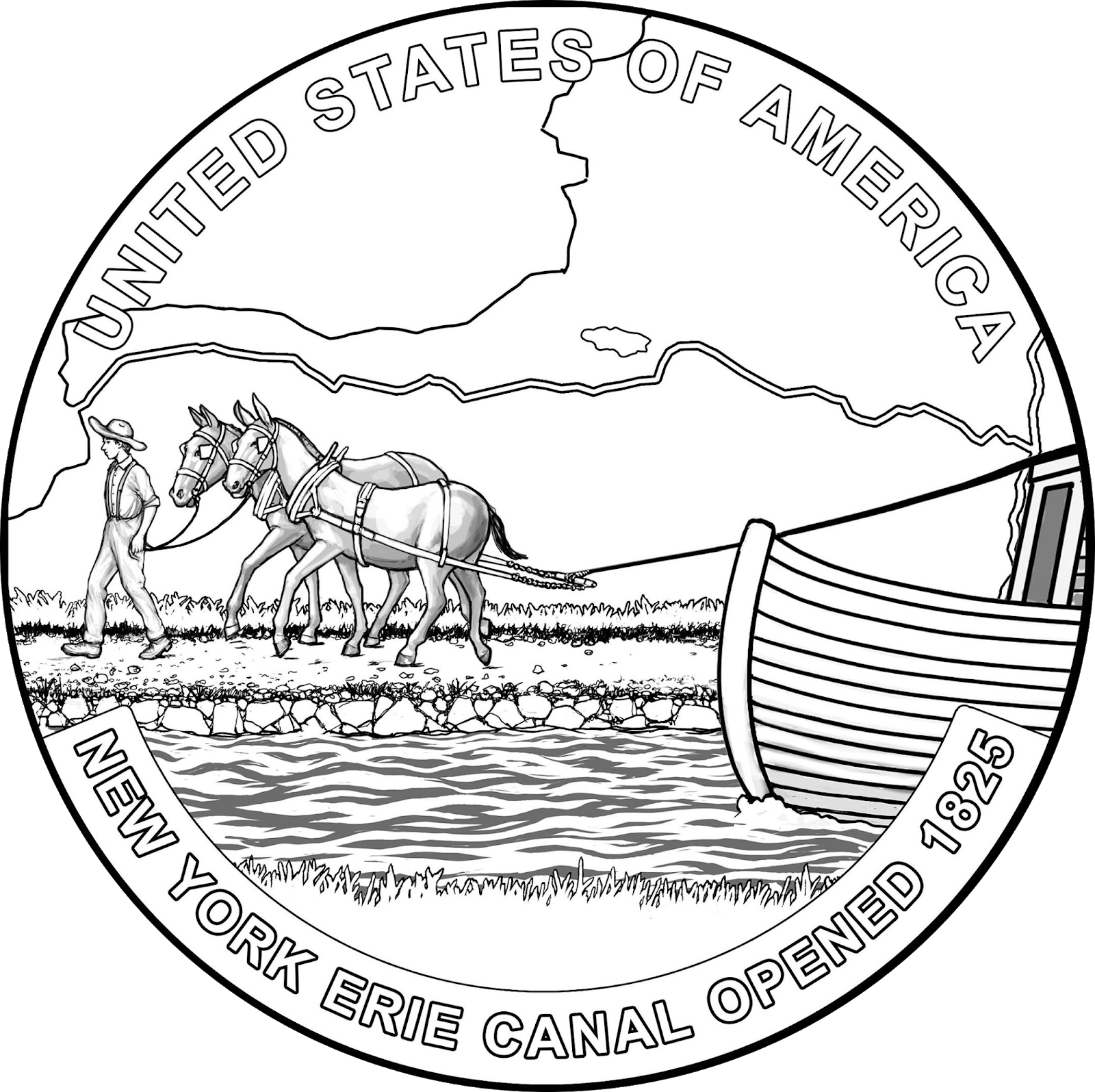
It looks like the Erie Canal will yet have its day on a United States coin. As shown below, a design depicting a mule-drawn barge on the Erie Canal was recommended by the U.S. Commission of Fine Arts for the U.S. Mint's American Innovation™ $1 Coin Program.

It’s not yet a sure thing. The design recommendation is subject to adoption by Secretary of the Treasury Steven Mnuchin, who has final say. It’s possible he might select one of the competing Erie Canal designs, shown below, or one of the baseball designs or Apollo lunar module designs that were submitted.

In any case, the final version won’t be known until the engraving is compete, translating the chosen design into a mintable coin.

As for those who prefer an image of the Statue of Liberty, fear not. She will appear on the obverse of each and every coin in the American Innovation Dollar Coin series.

For the coin that was actually minted, read Part II, here.

Alternative Erie Canal designs submitted:


Thursday, January 16, 2020

Suffrage’s Secret Song!

“Songs have been the not-so-secret weapon behind every fight for freedom, every struggle against injustice and bigotry.” ~ E. Y. Harburg


Here’s an easy question:

Which song is sung publicly more often than any other in the United States?

Answer: The Start Spangled Banner

(Happy Birthday to You is undoubtedly the most often sung, but in private rather than public settings.)

Here's a harder question:

Which song is sung publicly second most often?

(It's not Auld Lang Syne, which is sung publicly, but only once a year.)

Ready for a hint?

Seventh Inning Stretch

That‘s right, Take Me Out to the Ballgame, sung by crowds of strangers at just about every one of the thousands of baseball games played each year (albeit only the chorus).

How did the song get to be so well known?

It’s a long and fascinating story. Here's the short of it:

This 1908 song sold six million copies of sheet music in an era when there were only 20 million U.S. households. Perhaps one out of every three or four households had a copy. It was sung in the fledgling movie theaters that blossomed all over the country. Beautifully hand-colored “magic lantern” slides, projected on the screen, helped tell the story of “Katie Casey” who was “baseball mad.” However, it wasn‘t really about baseball! Without lecturing or preaching, it embraced the “New Woman,” a woman who was independent, outspoken, interested in sports, and deserved to vote! It was

Suffrage’s Secret Song!


The story tells of the songwriters, Jack Norworth and Albert Von Tilzer, the most famous female stars of the day – Trixie Friganza, Louise Dresser, and Nora Bayes (think Madonna, Lady Gaga, Barbara Streisand), Frederick and Louis Rueckheim – creators of Cracker Jack®, and the early history of movie theaters and music publishing. I'd love to tell you the whole story and sing the entire song accompanied by those 1908 song slides. Please see my upcoming shows or contact me to schedule a performance.

Credits:
  • The image of the woman and bicycle is adapted from the front cover of Jugend, 18 July 1896, No. 29.
  • The “Votes for Women” sash was made for the Women's Political Union in New York City, 1910-1915. (Image used with permission from Jeff Bridgman.)

Thursday, November 28, 2019

See the Erie Canal at the Movies

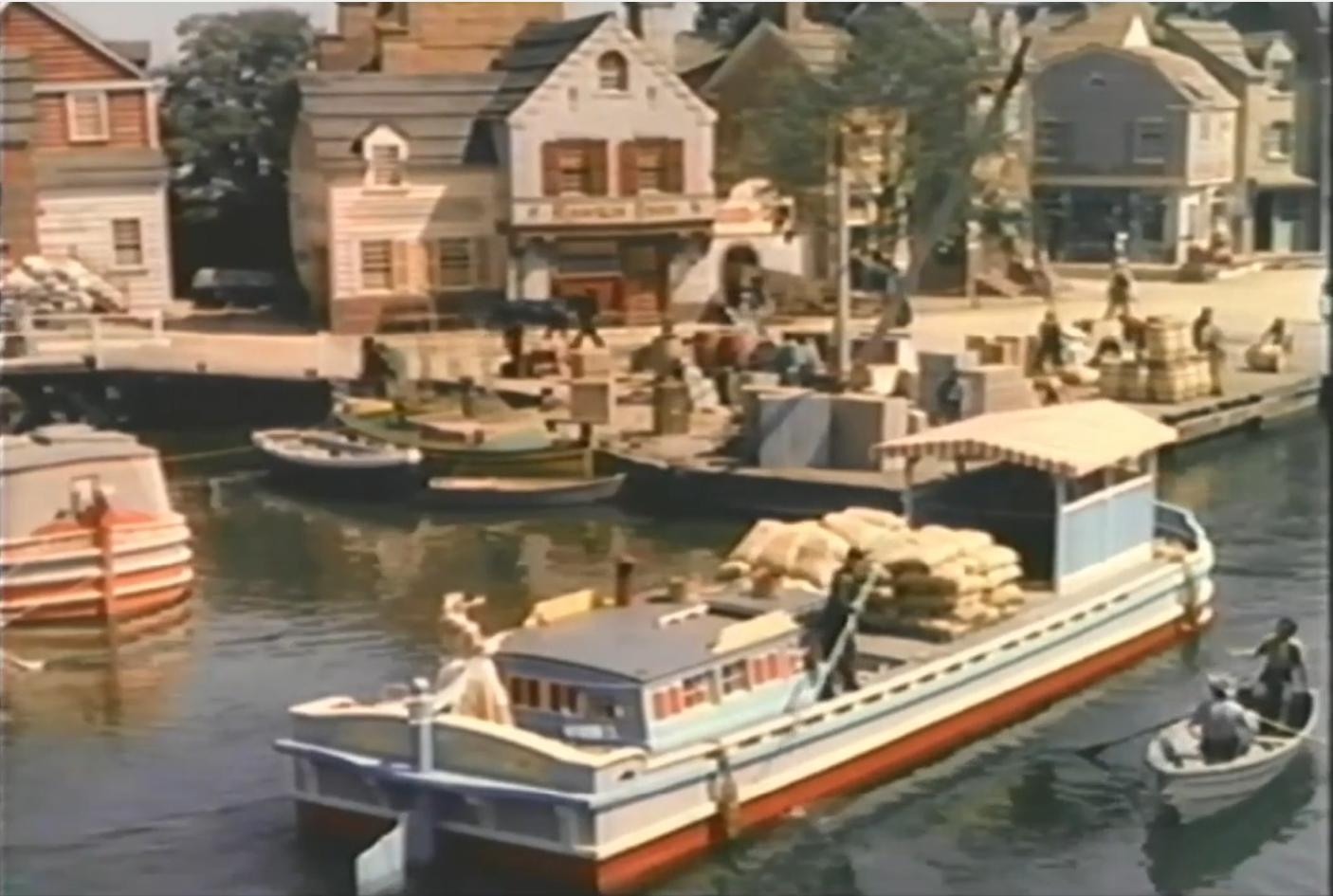
In honor of the the 200th anniversary of the Erie Canal (constructed 1817-1825), here are some movies – fictional and documentary – that feature the Erie Canal. Segments (minutes) are given that illustrate or describe the canal.

The Farmer Takes a Wife, 1935 (Wikipedia) (IMDB)

Based on the 1929 novel, Rome Haul, by Walter Edmonds (which was also the basis for the 1934 Broadway production (Wikipedia, IBDB)), most of this movie involves the Erie Canal. Stars Janet Gaynor and Henry Fonda (in his first movie appearance), directed by Victor Fleming. Many canal scenes appear throughout the movie. This scene, which takes place in a tavern, renders a comic version of Low Bridge, Everybody Down.

A DVD of the movie was released by 20th Century-Fox's Cinema Archives and is widely available. Also, you can watch the entire movie here.

The Farmer Takes a Wife, 1953 (Wikipedia) (IMDB)

Another movie based on Walter Edmond's Rome Haul, this one is a musical adaptation with songs by Harold Arlen and Dorothy Fields. Stars Betty Grable and Dale Robertson, directed by Henry Levin. Many canal scenes appear throughout the movie. You can watch it here. or here.


The Farmer Takes a Wife, 1940, 1953

The play was adapted for radio, twice! Listen or download the mp3 here:

Rio Grande, 1950 (Wikipedia) (IMDB)

As John Wayne leads the U.S. Calvary on horseback across the dusty desert southwest, he calls out, “Singers, give us a tune!” The chosen song? Low Bridge, Everybody Down (The Erie Canal Song). Stars Maureen O'Hara and John Wayne, directed by John Ford. Watch it here.
Minutes: 49:12-49:48

How the West Was Won, 1962 (Wikipedia) (IMDB)

This Cinerama epic spans many decades. It begins with the Erie Canal.

Minutes: 9:26-11:00 and 14:08-15:15

New York: A Documentary Film, 1999 (PBS) (Wikipedia) (IMDB)

Episode 1: The Country and the City (1609-1825);
  Chapter 10, A Larger Destiny: The Grid and the Canal
Minutes: 1:33:19-1:43:05

In the next episode of the series, Episode Two: 1825-1865, Order and Disorder, Chapter Two, The Metropolis of America, the important role of the Erie Canal in the growth on New York City is highlighted - minutes 6:38-8:03.

15 Miles On The Erie Canal - Part 1 (2006)


15 Miles On The Erie Canal - Part 2 (2006)

America's Heritage: The Erie Canal (1957)


Carver Companies Move GE Steam Turbines (2016)


 That's all for now! If you know of any other Erie Canal scenes at the movies, please let me know.

Sunday, November 10, 2019

1801 Election: The People’s Right aka Fair and Free Elections

Sheet music for "Election: The Peiople's Right," John J. Hawkins, 1801

ELECTION: THE PEOPLE’S RIGHT

John J. Hawkins, March 1801

For the inauguration of

President Thomas Jefferson

Later modified and entitled

FAIR AND FREE ELECTIONS

Tune: Yankee Doodle

While working on a story about Yankee Doodle (which is a great story, by the way), I came across the following song, written for Thomas Jefferson’s inauguration as President of the United States. Sing it to the tune of Yankee Doodle. Any inferences you might make as to its pertinence to current events are your own.

While some on rights and some on wrongs,
Prefer their own reflections,
The People’s right demand our songs
The Right of free elections.

Law and order be the stake,
With freedom and protections.
Let all stand by the ballot box,
For Fair and Free elections.*

For Government and order’s sake
And Law’s important sections,
We should support and pleasure take
In frequent Free elections.

Our Agricult’ral int’rest, Marts,
And Mercantile connections.
With Manufactures, Science, Arts,
Must thrive by free Elections.

To thwart the schemes of Factious bands
Who for us plan subjections,
The cause of Liberty demands,
Our Votes at all Elections.

Should enemies beset us round
Of foreign fierce complexions.**
Undaunted we can stand our ground
Upheld by free Elections.

Elections are to make us laws,
For trade, peace and protections
Who fails to vote forsakes the cause
Of Fair and Free Elections.*

We’ll never from our duty swerve,
Let who will make objections,
But while we live, unchanged preserve,
The Freedom of Elections.

* Verses in the Fair and Free Elections version that differ from the original.

** As used here, I take “complexion” to mean “a complex of attitudes and inclinations” or “overall aspect or character” rather than “the hue or appearance of the skin and especially of the face” (Merriam-Webster). Nonetheless, you might prefer alternative lyrics such as: “Intent on vote deflections,” “Changing our directions,” or “Tricking our affections.”

  • Oscar Brand’s recording of Fair and Free Elections appears in Election Songs of the United States, Smithsonian Folkways FW05280, 1960.
  • A digital copy of the original 1801 sheet music for Election: The People’s Right can be found in the Levy Sheet Music Collection.
  • For information about the controversial 1800 Presidential election (which was resolved after 35 ballots in the House of Representatives!), click here.

Tuesday, July 30, 2019

My Problematic Claim to Fame

It’s just not fair!!!

I was a winner of the Liars Contest at the 2019 Susquehanna Folk Festival.

But no one will believe me!


To avoid exposing the true liars, the Liars Contest was not recorded. However, since my story was an accurate presentation of what actually happened, I am happy to present the following transcript.

Please note: The attendees at the Susquehanna Folk Festival needed no explanation of local details. For others, a few explanatory notes may be helpful. (Feel free to contact me regarding any other details.)
  1. The Susquehanna Folk Festival Liars Contest took place in York County, Pennsylvania.
  2. You can hardly turn a corner without seeing a road sign that says, “Keep Pennsylvania Beautiful.”
  3. "Muskies" (muskellunge) are among the largest freshwater fish in North America. Some of the best musky fishing is in the Susquehanna River.
  4. Kudzu and purple loosestrife are among the most troublesome invasive plant species in Pennsylvania.
  5. A 25-foot replica of the Statue of Liberty can be found in the Dauphin Narrows section of the Susquehanna River, a few miles upstream from Harrisburg.
  6. Yellow Breeches Creek forms the  northern boundary of York County.

Here is my report, as given from the stage at the
Susquehanna Folk Festival Liars Contest.


I suppose you all know we’re in York County, but I didn’t know until I had a run-in with the York County Sheriff. He was going to fine me for littering. “Keep Pennsylvania Beautiful.” Hoping he would relent, I explained everything. He said, “Mister, I’m taking you in. I know just the place for you.” And he brought me here and said I had to explain it all to you. So, here I am.

You see, I’ve been reading a book entitled, The Pioneers, subtitled, The Sources of the Susquehanna. It was the first of five best-selling novels by James Fenimore Cooper with a character called “Leatherstocking.” I can see from all the heads nodding that you know what I’m talking about. The Leatherstocking Tales.

Anyway, reading this novel about the famous Leatherstocking, I wanted to see his cave, located on the steep mountainside above Otsego Lake in the part of New York the old-timers call “Leatherstocking Country.” If you’ve made the pilgrimage to the Baseball Hall of Fame you’ve been there, even if you didn’t know it. So, I hiked up there, and just as I got to Leatherstocking’s cave, what comes charging at me but a polar bear! Now I met this polar bear once before, up in the Adirondacks, and I knew he was making his way from the North Pole to the South Pole. You see, that bear was bipolar.

I didn’t want to be that bear’s breakfast, so I had to act quick. I could try to outrun him, or I could jump off the mountain. Luckily, I jumped off the mountain. As I was falling the 600 feet from the mountain down to the shore of Otsego Lake, suddenly I knew the answer to the great question about life, the universe, and everything. I wanted to write it down right away because, once I smacked into the ground, I was apt to forget it. So, I reached into my backpack for a sheet of paper. That paper was fluttering so wildly I had to hold onto it with two hands, and it billowed up above my head, and glided me down to a gentle landing on the shore of Otsego Lake.

I looked back up the mountain but, I was feeling pretty low. So, I reached into my backpack for my pot. I selected a nice hand-sized rock from the shore of the lake, and I hammered that big aluminum pot into a canoe and flattened my cook spoon into a paddle.

I paddled that canoe down Otsego Lake and there, at the southern end, was a sign said this was the source of the Susquehanna. It was such a tiny stream, I couldn’t believe it. I don’t believe anything unless I read it on the Internet because “the Internet is a credible and reliable source of information,” and that’s a direct quote from Abraham Lincoln. So, I figured I’d paddle down this little creek and see for myself if turned into the mighty Susquehanna.

After a distance, I got tired of paddling, and hungry too, so I was not displeased when the creek turned into Goodyear Lake. I figured I would catch me a fish. I saw a nice walleye down there, so I reached into my backpack and got my magnifying glass. Now a lot of old-timers use the magnifying class to concentrate the rays of the sun directly on the fish, and cook it down there in the water, but I have found that tends to cook the fish unevenly. The way I do it is to focus the sun’s rays just below the fish, so’s to heat up the water under the fish, and the upwelling of that warmed water lifts the fish right up. As it broke the surface, I reached out and caught that fish in my hand, filleted it with the sharp edge of my paddle, and played the magnifying glass across it so it cooked up evenly. It was the best magnifying-glass-caught-and-cooked fish I’d ever had. OK, that might be an overstatement. It was maybe only the second-best.

Fortunately, my attentiveness to that fish kept me from being distracted by all the people waving and hollering something about the Colliers Dam at the end of Goodyear Lake. The 35-foot drop over the dam and the rushing rapids below presented a welcome change of pace and speeded my journey considerably.

I won't bore you with how I trained a pair of muskies to tow the canoe, or the recipe I developed for a kudzu and loosestrife burrito. I will tell you this. As the river got bigger, I began to think this really was the Mighty Susquehanna and I had paddled down from its very source! But, as I was coming close to what I thought was Harrisburg, right there in the middle of the river, was the Statue of Liberty! I got suspicious and thought I’d better check my whereabouts. So, I paddled over to the shore and beached the canoe just past Yellow Breeches Creek. That’s when the sheriff fined me for littering. I give him credit. I’d be lying if I didn’t admit my hand-rock hammered canoe and paddle looked like garbage, even though you and I know different.

Anyway, I explained it all to the sheriff, and that’s when he brought me here. He offered me a piece of advice. “Mister,” he said, “if you say you paddled upstream from the Chesapeake, it will make a better story.”

“Sheriff,” I replied, “I wouldn’t lie just to tell a better story.”

Reprinted with permission from “My Problematic Claim to Fame” by Sandy Schuman, 2020, Voices: The Journal of New York Folklore, Vol. 46:1-2, pp. 43-45, © 2020 by New York Folklore.

Wednesday, July 17, 2019

The First Word Spoken on the Moon Owes a Debt to “Old Kinderhook”!

In Houston, they say the first word spoken on the moon was “Houston.” As Neil Armstrong said, “Houston, Tranquility Base here. The Eagle has landed.” But in New York, and especially in Kinderhook, we know differently.

In the late 1830s a verbal fad emerged from Boston. Using comically misspelled words and their initials, a common phrase such as “no use” became “know yuse” or “K.Y.”; “no go” became “know go” or “K.G.”; “enough said” became “nuff said” or “N.S.” Like all fads, this one died, with one notable exception.

The use of “O.K.” for “oll korrekt,” a comic misspelling of “all correct,” first appeared in the Boston Morning Post of March 23, 1839 and was soon picked up by other newspapers.


The use of "O.K." would have been another short-lived fad except for the 1840 presidential campaign. Martin Van Buren, a native of Kinderhook, New York, ran for re-election as President of the United States during a weak economy that many blamed on him. To bolster his image, his campaign recalled “Old Hickory,” the nickname of the popular former president, Andrew Jackson, and called Van Buren “Old Kinderhook.”


Not coincidentally, “Old Kinderhook” shared the same initials as the trending “O.K.”, and “OK Clubs,” supporting Old Kinderhook’s candidacy, abounded. “Old Kinderhook” was “OK.”

The opposing candidate, William Henry Harrison, turned this to his own advantage by using “OK” to denigrate Van Buren, calling him “Out of Kash,” “Orfully Konfused,” and “Orful Katastrophe.” Harrison won in a landslide.

Propelled by the presidential campaign, “OK” soon became entrenched in American English and has since been adopted by many languages. Arguably, it is the most popular word in the world.

As for the first word spoken on the moon, listen carefully to the recorded voices of Buzz Aldrin and Neil Armstrong as the Eagle approaches the moon. You will hear Buzz Aldrin say, “contact light” (at 0:39), meaning the 67-inch probe beneath the lunar lander contacted the surface and, four seconds later, “OK, engine stop,” meaning the Eagle came to rest on the lunar surface and the engine was turned off.


“Old Kinderhook” would be proud.


Note: This much-abbreviated history of “OK” is in debt to Columbia University Professor of English, Allen Walker Read, who published a series of six articles on the subject in American Speech in 1963 and 1964. His research was summarized and expanded by Allan Metcalf in his 2012 book, OK: The Improbable Story of America's Greatest Word.


For details of the first lunar landing, see the Apollo 11 Lunar Surface Journal, https://www.hq.nasa.gov/alsj/a11/a11.landing.html. For high-definition video and audio recordings, see Moonscape https://moonscapemovie.blogspot.com/.

Use of the "Old Kinderhook" historical marker is courtesy of Christopher Kline, author of O.K. – The Musical.