Thursday, April 25, 2019

The Fly Fishing Contest at Chelm's Pond


One day, after she had to rearrange the tables because everyone wanted to sit close by to hear his story, Bloomie heard someone ask, “Did you ever compete in one of those contests like they have at the Tupper Lake Woodsmen’s Days?” Part of her wanted to listen to his story, but she was still angry. Everyone else sat expectantly, eyes and ears fixed on the woodsman, poised on their chairs. In spite of her feel¬ings, Bloomie felt the need to understand this adventurer and listened intently, disguising her attention by cleaning tables.

“Oh yes, I used to enter contests all the time,” he began, “but then I stopped. It wasn’t fair, me winning all the time, so after I won the fly fishing contest, I gave them up so others could have a chance.”

“The fly fishing contest,” they all said. “Tell us about that one.”

“There was a rich fellow from New York City who wanted to hire an Adirondack guide to take him fly fishing, and he wanted the very best fly fisherman there was, so he sponsored a contest. The winner would receive a cash prize and a lucrative year-long contract to take him fly fishing. The rich man advertised and sent out mailings to all the Adirondack guides and even published a set of contest rules. When the guides read those rules, they realized this New York City man had a funny idea of what ‘fly fishing’ meant.

“On the appointed day all the Adirondack guides turned out to compete in the contest. The crowds of spectators were so great that the sheriff had to call in deputies from the five surrounding counties just to direct traffic, order three dozen Porta Potties dropped in by helicopter so as to avoid a health and sanitation crisis, and establish an emergency hospital tent in the event that the severity of mosquito bites should make mass blood transfusions necessary.

“The first Adirondack guide came up to the platform.” The young woodsman paused as he stood up tall and folded his arms over his chest. “His voice boomed over the excited throng. ‘I am here to enter the fly fishing contest and my name is Mountain Manny.’ The crowd went wild with clapping and cheering and whistling. Mountain Manny was well-known throughout the region and famous for his skills as an angler. He was big, too, over six feet tall and he weighed more than 200 pounds – before he ate breakfast. He took out his fly rod and laid it on the ground. He reached into his pocket and withdrew a matchbox. He opened the matchbox and revealed a stonefly.

Now, you know trout love those stoneflies. They make a pretty good meal for a fish, and they can be more than an inch long, maybe two. Mountain Manny released the stonefly into the still summer air and everyone lifted up their binoculars to follow it as it flew higher and higher. Mountain Manny picked up his fly rod and flicked it back and forth in careful, measured motions, let out nearly all of the line, and hooked that stonefly mid-air in a matter of just seconds. He reeled it in and proudly displayed it to the crowd, a smile from ear to ear and back around again.

“Well you never heard a crowd of people go so wild like they did that day. They wouldn’t have believed it, except that they saw it through their own binoculars. Shaking their heads in disbelief, many of the other Adirondack guides just packed up and went home. Mountain Manny was getting ready to collect his prize and sign the fly fishing contract when another guide stepped up to the platform.” At this, the young woodsman stood on top of his chair, causing all of the Chelmites to lean back in their chairs and crane their necks so they could see him. “He announced in a voice so loud it made the air shake, ‘I am here to enter the fly fishing contest and my name is Giant Jim.’ He stood there so tall he made Mountain Manny look like you were seeing him through the wrong end of your binoculars. That Giant Jim must have stood six foot ten inches tall and weighed 300 pounds. He really was a giant.”

The Chelmites at The Broiled Beet pulled their chairs closer so they wouldn’t miss a word, their eyes fixed on the young woodsman.

“He reached into his pocket, took out a matchbox, and released a mayfly. Now there isn’t an insect the trout like more than a mayfly, even though they’re only about a half-inch long. Everyone lifted their binoculars and followed that mayfly as it took off on a light summer breeze. Giant Jim took his time and looked through his fly fishing rods, carefully deciding which one to use, as the mayfly drifted further and further away. Finally, he selected a rod, picked it up, and gracefully flicked his wrist, letting out the line in long arcs – it was beautiful just to watch him, big as he was, gently working that rod and that big curving loop of line. Then, with a perfectly-timed flick of his wrist, the rod arced back, the line followed, and he hooked that mayfly. He reeled in the line and held that tiny hook between his fingers, showing off that tiny mayfly he had caught on the wing. The crowd erupted in applause accompanied by hootin’ and hollerin’ louder than a family of long-tailed cats in a room full of rockin’ chairs.

“At this point the few remaining would-be competitors somberly packed up their fly fishing equipment and tried to look like they had never been there. The judge was about to award the prize to Giant Jim and have him sign the contract when I stepped up to the platform.” Now the young woodsman stepped down from his chair and took his no-more-than-average-height stance in front of the crowd. “I said, in as big a voice as I could muster, ‘I am here to enter the fly fishing contest and my name is Adirondack Mendel.’”

The Chelmites perched on the edges of their chairs, leaning forward so far that three of them fell over on their faces, but they were so entranced by the story that they didn’t even feel embarrassed. Immediately they resumed their postures, listening keenly to every word.

“Mountain Manny and Giant Jim looked around trying to find me, seeing as I am much shorter than they and not so imposing a figure, until finally they looked down and saw me and – gracious gentlemen as they were – gave me some elbow room so I could enter the competition. I reached into my pocket, pulled out a matchbox, opened it slowly, and out flew a noseeum.

Now, of course, you know that a noseeum is so-called because these blood-sucking, flying piranhas are so tiny you ‘can’t see them,’ so everyone immediately raised their binoculars, turned the knobs to maximum magnification, and whipped their heads around to keep the little noseeum in view as it was buffeted around by the gusty summer wind. Meanwhile, I calmly picked up my fly fishing rod and in a few swift motions had the full length of line swooping back and forth from one end of the crowd to the other. Then, with one seamless movement of my arm and wrist, I was done, confident that I had displayed the greatest skill and won the contest. I reeled in my line, leaned my rod in the corner, and stood there proudly, my arms folded over my chest, ready to receive my prize and sign the contract.

“The crowd continued to watch the noseeum flit around in the wind and the judge seemed puzzled. He pointed to the wind and said to me, ‘You made a great show of it, but the noseeum is still flying.’

“In reply, I declared, ‘My dear judge, circumcision is not meant to kill.’

“And that’s how I won the fly fishing contest.”

The Chelmites, honored to be in the presence of this famous Adirondack guide, slapped him on the back, shook his hand, and wished him mazel tov. He acknowledged each of them by name and, to those he didn’t know already, made a brief introduction. He was pleased to attract such a grateful crowd. But in the midst of all these admirers, Adirondack Mendel’s eyes searched for the one person whose attention he most desired. Across the cafĂ© he spied Bloomie as she cleaned a table, a charmed smile lingering on her face. But in the next moment, she caught him looking at her, and her expression turned to stone. I’d better stick to my own business, he thought, and bide my time with Bloomie.

Sunday, November 25, 2018

I Got Latkes

Just when you thought there were enough Chanukah songs already ...

I Got Latkes

Based on I Got Rhythm by George and Ira Gershwin, ©1930
Chanukah lyrics by Sandy Schuman 2017


I got latkes
I got dreidels
I got candles
Nes gadol haya sham

I got gelt and
I got oil
Sufganiyot
Nes gadol haya sham

Antiochus
Matisyahu
Maccabia
Chanukia
Fry the latkes
Spin the dreidels
Light the candles
Nes gadol haya sham

Shehecheyanu
Vekiyemanu
Vehigyanu
Lazman hazeh
.

I got latkes
I got dreidelsI got candles
Who could ask for anything more

Wednesday, September 26, 2018

Be Kinder to One Another: A Tribute to George Gershwin at 120

Vulcans say, “live long and prosper.” Jews say, “biz hundert un tsvantsik,” “may you live until 120.” For example, one might say, “Happy birthday! Biz hundert un tsvantsik!” It is based on the Biblical verse, “Moses was a hundred and twenty years old when he died; his eyes were undimmed and his vigor unabated” (Deuteronomy 34:7).

Undoubtedly, George Gershwin was familiar with this Yiddish expression and was likely wished biz hundert un tsvantsik many times. Tragically, his lifespan didn’t come close; he died of a brain tumor at age 38. In crafting my own stories about George and Ira Gershwin, I have come to appreciate George’s extraordinary, creative, exuberant life. Born September 26, 1898, he would have reached 120 years today. To honor his memory, I would like to share with you the eulogy delivered by Oscar Hammerstein II at the George Gershwin Memorial Concert at the Hollywood Bowl on September 8, 1937.*
To George Gershwin

Our friend wrote music, and in that mould he created gaiety and sweetness and beauty. And 24 hours after he had gone his music filled the air and in triumphant accents proclaimed to this world of men that gaiety and sweetness and beauty do not die.

A genius differs from other men only in that his immortality is tangible. What he thought, what he felt, what he meant has been crystallized in a form of expression, a form far sturdier than the flesh and sinew of the man. But lesser beings than geniuses leave their marks upon this earth, and it is as a lesser being that George Gershwin’s friends knew him and loved him.

We remember a young man who remained naive in a sophisticated world. We remember a smile that was nearly always on his face, a cigar that was nearly always in his mouth. He was a lucky young man, lucky to be so in love with the world, and lucky because the world was so in love with him. It endowed him with talent. It endowed him with character. And, rarest of all things, it gave him a complete capacity for enjoying all his gifts.

It was a standing joke with us that George could not be dragged away from a piano. He loved to play the piano. He played well, and he enjoyed his own playing. How glad we are now that some divine instinct made him snatch every precious second he could get at that keyboard, made him drink exultantly of his joy-giving talent, made him crowd every grain of gratification he could get into his short, blessed life.

Maybe the greatest thing he left us is this lesson: Maybe we take the good things of life too much for granted. Maybe we took George too much for granted. We loved him. Should we not have loved him more? Have we ever loved him so much as we do now? Have we ever said so as we do now? We are all inadequate, muddling humans with hearts and minds woefully unequipped to solve the problems that beset us. We are eloquent in the recognition of our troubles. Why are we not equally eloquent in the recognition of our blessings, as George was?

Some will want a statue erected for him. He deserves this. Some will want to endow a school of music in his name. He deserves this. But his friends could add one more tribute: In his honor they could try to appreciate and be grateful for the good things in this world. In his honor they could try to be kinder to one another—and this would be the finest monument of all.

*Sources: George Gershwin. Merle Armitage, ed. New York: Longmans, Green, 1938, p. 1-4. The George Gershwin Reader. Robert Wyatt, John Andrew Johnson, eds. Oxford: Oxford University Press, 2007, p. 272.

Friday, August 11, 2017

My Father was a Songwriter

Copyright 1952

Yes, it’s true, my father was a songwriter. He wrote more than 80 songs, many of them with Tony Messina. Tony wrote the music, my father wrote the words. I tell a story about how, as a kid, I became curious about how they wrote songs. So I went downstairs, where they were working at the piano, to observe them in action.

As soon as I entered the room, they stopped. Tony spun around on his piano stool and asked me about school, my favorite subjects, my Boy Scout activities …. I realized they were not going to write songs while I was present.

So, I went back upstairs. And then, after considering the ethical issues, I sneaked into the stairwell, unbeknownst to them, and I heard how they wrote songs. It’s a good story. I’d like to tell it to you sometime. Stay tuned.

For now, I’d like to focus on the ending of the story. In the past, I ended with their song, Bright Tomorrow. It’s a good song and a fitting conclusion.

But, it’s not their best song. Recently, at CaffĂ© Lena, I concluded the story with this one. I think it is perhaps their best:

The Worm is Gonna Turn On You, Music by Anthony Messina, Words by Samuel Schuman, Copyright 1952.

As I listen to that recording—I'll admit it deserves a better rendition—I think I like my father’s version better!

The Worm is Gonna Turn On You, performed by Samuel Schuman.

Saturday, November 12, 2016

Song of the Century, Part 2: Get Happy!

Harold Arlen started out as a piano player and singer. This is the story of how he became a composer of popular music.

Saturday, July 9, 2016

We’re in the Same Boat, Brother

(aka “We Are in the Same Boat Brother”)

We’re in the same boat, brother
And if you shake one end
You’re gonna rock the other
It’s the same boat, brother

(Links to various recordings are below.)


We’re in the Same Boat, Brother

Words by E.Y. Harburg, Music by Earl Robinson, © 1944 Harburg and Robinson

Oh the Lord looked down from his holy place
Said, “Lordy me, what a sea of space
What a spot to launch the human race.”
So he built him a boat for a mixed up crew
With eyes of black and brown and blue
And that’s how come that you and I
Got just one world with just one sky

Chorus:

We’re in the same boat, brother
And if you shake one end
You’re gonna rock the other
It’s the same boat, brother

Oh the boat rolled on through storm and grief
Past many a rock and many a reef
What kept ’em goin’ was a great belief
That they had to learn to navigate
’Cause the human race was special freight
If we don’t want to be in Jonah’s shoes
We’d better be mates on this here cruise

When the boilers blew somewhere in Spain
The keel was smashed in the far Ukraine
And the steam poured out from Oregon to Maine
Oh it took some time for the crew to learn
What’s bad for the bow ain’t good for the stern
If a hatch takes fire in China Bay
Pearl Harbor’s decks gonna blaze away

Reading this morning's newspaper (January 29, 2017) I wrote a new verse:

When the ice cap melt overfilled the seas
When the shorelines surged with refugees
And the courts were filled with desperate pleas
While fires made the smokey air
And rising floods made life despair
Oh it took some time for the crew to learn
What's bad for the bow ain’t good for the stern
 

... When one group shouts a loud hooray
The other group can’t just walk away

I thought We're in the Same Boat, Brother was an early civil rights song by Huddie Ledbetter, the folk singer better known as “Lead Belly.” It turns out to be a civil rights song – and much more.

I couldn’t make out all the words from Lead Belly’s recordings so I turned to the World Wide Web expecting to find the lyrics without any difficulty. However, after much searching, I found only recordings and videos of the song by Lead Belly and an even larger number by Bhupen Hazarika, a popular Indian singer of whom I had never heard. Finally I found a forum where a few people were carefully listening to Lead Belly’s recordings and piecing together the lyrics line by line. And then, more than four years after the original inquiry was posted, someone posted the authoritative lyrics from The Collected Reprints from Sing Out!: The Folk Song Magazine, Volumes 7-12, 1964-1973 pp. 110-111.* And this source showed the song was not a folk song, not written by Lead Belly, but rather by E.Y. Harburg (words) and Earl Robinson (music). It was written amidst the strife of World War II and was featured in Norman Corwin's hopeful CBS radio program, Unity Fair, which aired on July 3, 1945, just days after the signing of the United Nations Charter on June 26. (You can hear the song at minute 22:00 of the show, sung by the One World Chorus.)

Still, I couldn't figure out the chords to play on the guitar. I searched for sheet music and finally found a song book entitled 12 Negro Spirituals published in Denmark! Most vendors who showed the booklet said it was "not available." One seller, in the UK, would sell it for about $10 plus $25 shipping. So, expecting that it would be available from one of the larger university music libraries, I requested it via inter-library loan. When finally it arrived, it bore the stamp of Det Fynske Musikkonservatorium, now the Danish National Academy of Music, and was sent airmail from Esbjerg, Denmark. I felt guilty for the expense!


* You can order a copy of the song from Sing Out! magazine.

Bhupen Hazarika did more than anyone to internationally popularize "We're in the Same Boat Brother" (which he typically sang as "We are on the same boat, brother"). In many of the related accounts, the song is incorrectly attributed to Paul Robeson. When Bhupen Hazarika was studying at Columbia University in New York City, he knew Paul Robeson and might have learned the song from him. Paul Robeson undoubtedly knew Earl Robinson, who wrote the music for the song; Robeson recorded other Robinson songs such as Ballad for Americans and Joe Hill.

Here is some additional background information from various sources.

Introductory notes: The Collected Reprints from Sing Out!: The Folk Song Magazine, Volumes 7-12, 1964-1973, pp. 110-111

Composed originally in the waning days of World War II, this song was a popular folk-style appeal for the United Nations. Leadbelly was enthusiastic about the song and sang it constantly. The composers are a distinguished team. Earl Robinson, many of whose songs have appeared in these pages, is composer of “Joe Hill,” “Ballad for Americans,” “Lonesome Train,” “House I Live In,” “Black and White,” and scores of other works. E. Y. “Yip” Harburg is best known for the libretto to “Finian's Rainbow.” He is also author of the lyrics to the songs in the film version of “Wizard of Oz,” and lyricist for that depression classic, “Brother Can You Spare A Dime?” Harburg and Robinson also collaborated on “Free and Equal Blues.”

Introductory notes: Earl Robinson Sings, Folkways FG 3545

The usual relationship between folk music and the composer is where the latter discovers some of the beauty and excitement in a folk song and says to himself , ‘I can do something with that.’ So perhaps he arranges it simply or complexly, for an interesting group of instruments, or even a full orchestra, moving the folk song onto a new level. Some composers immerse themselves in a folk style so well that they don‘t find it necessary to quote exact tunes, but create new works while still giving the feeling of folk derivation. Men like Vaughn Williams, Bartok, Villa Lobos come to mind.

As a composer I have taken part in all these processes. But it has been my particular fortune to also have the opposite happen. Huddie Ledbetter, (perhaps the king of all the folk singers), not only took sections of the “Lonesome Train” to sing, but liked “The Same Boat, Brother” well enough to make it his own. If you listen to his recording sometime you will hear the folk process at work, in reverse so to speak.

Yip Harburg and I met in Hollywood early in 1944 and out of this came not only some movie scores but songs like “Free and Equal Blues” and “Same Boat.” The latter received an early climactic performance in San Francisco over the CBS network at the formation of the United Nations. Since then it has had no similar large scale performance. But it has made its way around nevertheless, through hundreds of copies distributed by the Y.W.C.A. plus the inexorable folk process. Still a good idea for singing.

Introductory notes: Who Put the Rainbow in the Wizard of Oz?: Yip Harburg, Lyricist, by Harold Meyerson, Ernie Harburg, p. 217.

Another [high point in Yip’s career as the bard of left liberalism] was to come the following spring after the San Francisco conference that established the United Nations. Radio producer Norman Corwin put together a live broadcast from San Francisco that CBS carried nationally. It was entitled “Unity Fair,” and Yip provided the songs and some of the script as well. The broadcast was almost an anthology of Yip’s popular front work: it included performances of “The Son of a Gun Who Picks on Uncle Sam,” Meet the People’s “It’s Smart to be People,” and a new Robinson-Harburg folk song, “The Same Boat, Brother.” The new entry was directed against postwar isolationism and intended to promote a one-world perspective—indeed, it was given its inaugural performance by the One World Chorus.

Here are links to various recordings.


Unity Fair radio broadcast, July 3, 1945, performed by the One World Chorus at minute 22:00 of the show.

Earl Robinson: Earl Robinson Sings Earl Robinson: Earl Robinson Sings

Lead Belly: Lead Belly's Last Sessions

Bhupen Hazarika:

Lou Majaw, Papon, Angarag Mahanta at the 12th South Asian Games:

Bengali Lyric:


Kevin Russell and Shinyribs at the Albino Skunk Music Festival:

Zubeen, Nahid, Papon, Choir Group


Randy Kaplan: Five Cent Piece

Long John Baldry: Remembering Leadbelly

Bill Lake & Rick Bryant: We're in the Same Boat, Brother (library citation) (album cover

Sunday, October 25, 2015

Sandy's Seven Sagacious Storytelling Sayings

OK, I’m a sucker for alliteration. Nonetheless, when I led a series of storytelling sessions, six days in succession, each with a new set of students, I noticed myself saying the same things over and again. As it turned out, they numbered seven. So here they are, pearls of storytelling wisdom or otherwise, Sandy's Seven Sagacious Storytelling Sayings. (Download a pdf version here.)

1. An audience of one.

One of my early storytelling performances was at a Tellabration organized by the Story Circle of the Capital District. We were eight tellers and about 350 people in a semi-circular theater that held about 400. A wonderful turnout. When my turn came I stood alone on the stage and slowly turned my gaze from left to right, trying to acknowledge and connect with the audience. I told Lucky Numbers, a story about my father, and how I had questions I would like to ask him, questions that I realized only after he had died.

After the performance, the tellers and many people from the audience gathered in a nearby restaurant for “beer and cookies” – and more stories. One man, whom I had never seen before, came up to me and shook my hand. “Thanks for that story,” he said with tears in his voice, “I needed to hear that.” That’s all he said, and then he disappeared back into the crowd. Since then, I try to remember that it’s not the audience who hears a story, but each individual person. One person, perhaps, will find something meaningful in my story. I have to tell my story to only that one person and it will be worthwhile. And if it is meaningful to that person, it is probably meaningful to others.

2. Tell the ending.

It is my dream to tell An Evening of Endings, a storytelling performance built around the last lines of my stories. In my dream, I offer the audience a list of endings and they get to choose which ending they would most like to hear. All I really want is to tell the ending of the story; that’s what counts most, it’s why I want to tell the story in the first place. But, for it to have any meaning, I need to tell them the beginning and the middle.

Put another way, it’s easy to rehearse your story, starting at the beginning each time, and pay a great deal of attention to the beginning and the middle, but then run out of rehearsal time before you get to the end. If, when you rehearse the next time, you start again at the beginning, you may never spend adequate time thinking through and rehearsing the end.

Put yet another way, when you develop a story, pay attention to the beginning, because that’s what attracts the listener’s attention, and pay attention to the middle, because that’s what carries the story and retains the listener’s attention. But most important, pay attention to the ending, because that’s what brings it all together – and generates the applause.

3. Use the Vulcan Mind Meld.

I have long admired the Vulcan Mind Meld as a perfect form of communication. (If you are not familiar with it, this is a method used in the science fiction world of Star Trek to join minds together – “My mind to your mind, my thoughts to your thoughts.”) Since it is a fictional ideal, we must use the next best things: images and words. As a storyteller, I might think my vehicle is words. But this is incorrect. In my head I have an image, and I want to get that image into your head. Words are the vehicle, but the image is their source and destination. By being aware of the images I have in my head, and how I zoom in or out and switch from one to the next, I can tell a better story and produce better images in the heads of my listeners.

4. Tell a story that the listener needs to hear, or one that you need to tell.

I attended a dinner at a professional conference and sat next to a person I had only recently met. Before long, steeped in conversation, she started telling me about her sister. It seems her sister struggled with severe social anxiety and was under the care of a doctor who managed her medications. After listening for some time, I told her the story of the Turkey Prince. I didn’t know if that story would be of any help but I thought it might. When she saw me the next day she came over to thank me for telling that story. It is a good day for storytellers when the stories they tell are useful for their listeners to hear.
Sometimes I tell a story because I need to tell it. It represents something meaningful and important to me and I feel good when I tell it. With apologies to Descartes, “I have shared my story, therefore I am.” When the story I need to tell and the story the listener needs to hear are the same story, it is a very good day.

5.There is always another side to the story.

Whenever I or one of my sisters would complain about what someone did, describe what happened in some incident, or comment on something we read in the newspaper, my father would say, “there is always another side to the story.” It helped us build perspective, to appreciate that no matter how confidently someone told their side of the story or how sure we were of our own understanding, there was always another way to look at it. For a storyteller, this is all so true. We can tell a story from the point of view of any of its characters or objects. And even if we don’t, it’s often useful to think about the story from different perspectives as a way to gain a fuller understanding of the story. But we don’t have to tell every side of a story, we need only tell one side – and let the listener wonder about the others.

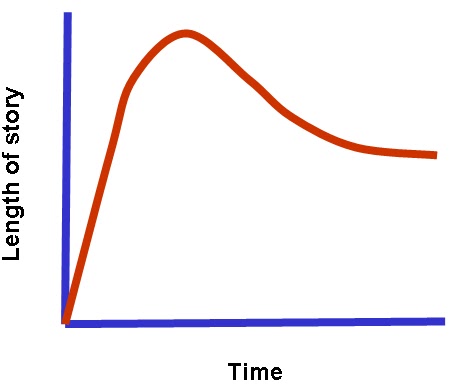
6. My story gets longer before it gets shorter.

I usually start with an idea – or some related ideas – of a story and then develop it. Whether I write it down in narrative or outline form, or keep it all in my head, it grows. It gets longer and wider and then, as I shape the story – deciding which details to omit, retain, add, and expand – the story starts to get shorter. I allow the story to get messy, knowing that before long it will settle down. I’m not smart enough to know how it will end up, so I have to wait to find out. And that’s OK.

7. Every story I tell is a story about me.

This is clearly the case when I am telling a story about myself, or a story about family or friends where I am a character in the story. But I am trying to say something broader. Every story I tell says something about me. The stories say something about me simply because I choose to tell them. They are meaningful to me – I am attracted to them in some way, and that says something about me. The way I tell it, what I emphasize, what I omit, what I change, what gestures and expressions I use, how I involve the listeners, all tells a story about me. If you have a story that isn’t about you – about what you find important, meaningful, humorous, intriguing – don’t try to make it fit; don’t fake it. Instead, tell a story that says something about you.


So ends Sandy's Seven Sagacious Storytelling Sayings. They are not sufficient! I’m eager to savor the succinct storytelling suggestions you supply.

This article appeared in Storytelling Magazine, 31:2 (June) p. 15. (2019). Download a pdf version here